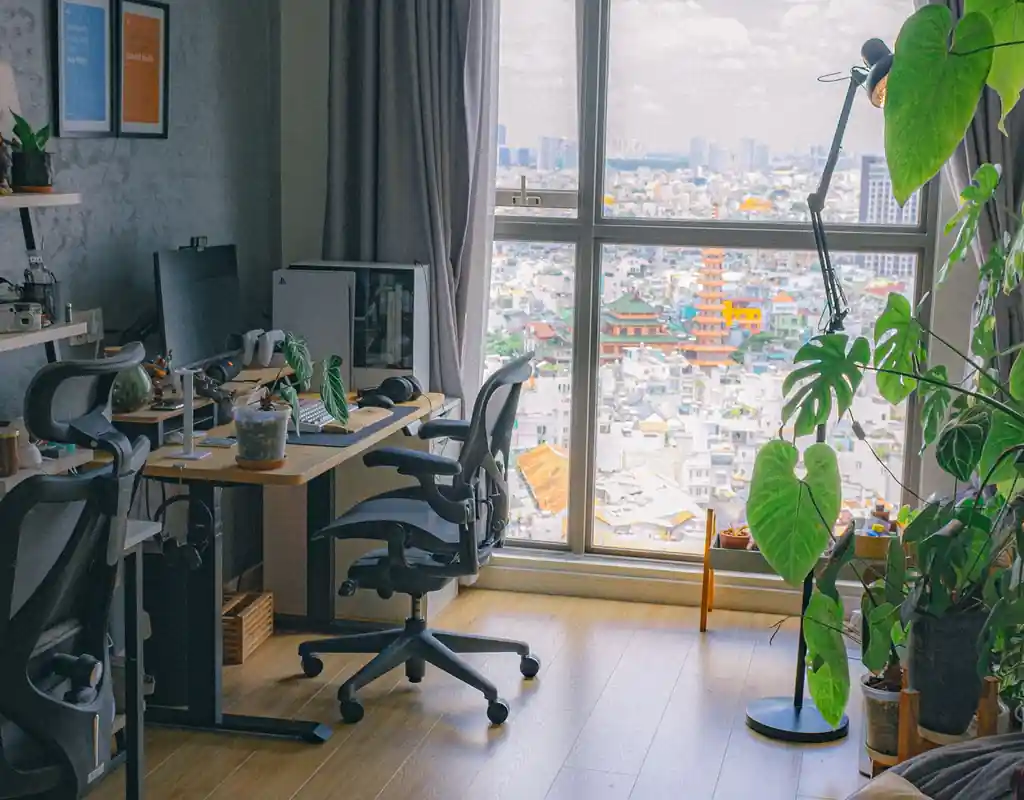
A window can be the best thing about a small office or the most annoying thing about it, depending entirely on what you do with it. The window itself doesn’t change — what changes is whether you’ve dealt with the glare it causes on video calls, whether the sill is wasted space or useful storage, and whether the light coming through it works with your setup instead of against it.
This isn’t about where to position your desk relative to the window or which lamp to add — our Lighting Ideas guide covers desk placement and glare on the screen in detail. This is about the window itself: what covers it, what sits on it, and how its light changes through the day and the year.
Choose Window Treatments for Control, Not Just Style
The right window covering does two jobs at once: it controls how much light gets in, and it controls how private the room feels, especially on video calls. Most small offices end up with whatever curtains came with the room, which usually means neither job gets done well.
- Sheer curtains soften harsh direct sun without blocking the room’s light entirely — useful for a window that gets strong afternoon sun on one side of the desk.
- Cellular or roller blinds give more precise control, since they can be raised partway to block a specific angle of sun while leaving the rest of the window open.
- Blackout blinds or curtains matter most when the room needs to go fully dark on demand — a home office that doubles as a bedroom, an early riser who needs to sleep past sunrise, or anyone who naps or needs the room dim during the day. As a side benefit, they can also block a bright window during an early or late video call.
If you’re not sure which category fits your situation, think about what problem you’re actually trying to solve — glare during the day, privacy in the evening, or both — and choose the treatment built for that specific problem rather than whatever looks best in photos.
Solve the Video-Call Backlighting Problem
A window behind you during a call washes you out into a silhouette, no matter how good your camera is — the camera exposes for the bright window, not your face, and there’s no lighting fix on the desk side that solves it.
If moving the desk isn’t practical — our Layout Ideas guide covers repositioning options — the window itself is the easier fix: a sheer curtain or partially closed blind diffuses the backlight enough that the camera can expose properly for your face instead of the window. Even closing a blind halfway during calls, then opening it back up afterward, solves the problem without any new purchase.
Put the Sill and Surrounding Wall to Work
A window sill in a small office is either dead space or a small but genuinely useful shelf, and the difference is just whether anyone decided to use it.
Deep sills can hold a slim tray of small plants, provided they don’t block the glass enough to matter for light. Narrower sills work well for a single object — a small clock, a photo, a compact speaker — that would otherwise take up desk space. If the sill itself is too shallow to use, the wall directly beside the window is usually open too, and a slim vertical shelf there captures storage space that a wider shelf placed elsewhere in the room would have to compete for.
Whatever goes on the sill is also one of the more visible spots in the room, so it’s worth keeping it in step with the wall color and overall palette rather than treating it as an afterthought — our Color Ideas guide covers choosing a palette that keeps a small office feeling open.
Account for How the Light Changes Through the Year
Light through the same window looks completely different in December than it does in June, and a setup that works well in one season can become a glare problem or a gloom problem in another.
A desk that gets gentle morning light in summer might catch direct low-angle sun for an hour each way in winter, when the sun sits lower in the sky year-round. If your window setup was arranged during one season, it’s worth rechecking it after a few months — an adjustable blind or a curtain that can be repositioned handles this better than a fixed treatment that assumes the light will always behave the way it did when you set it up.
Use Window Film for Glare Without Losing the View
For a window that causes glare at a specific time of day but where you don’t want to lose the outside view entirely, anti-glare or light-filtering window film is worth considering before defaulting to a blind.
Some films can reduce brightness and UV exposure while keeping the window transparent — performance varies by product, so it’s worth checking the specific film’s ratings rather than assuming all films perform the same way. The appeal for a small office is keeping the view intact where blocking it entirely with a blind would make the room feel more closed in, which matters more in a space that’s already working with limited square footage. Film is also more permanent than a blind, so it makes the most sense for a window with a predictable, recurring glare problem rather than one that only causes issues occasionally.
Mind the Temperature the Window Brings With It
A window doesn’t just bring light into a small office — it brings temperature swings that a larger room absorbs more easily. A west-facing window can turn a small office uncomfortably warm for an hour or two each afternoon, while a poorly sealed older window can leave a desk noticeably colder in winter than the rest of the room.
A cellular shade adds a layer of insulation without sacrificing much light control, and it’s a low-effort fix for a window that’s making the room’s temperature harder to manage than the room’s size alone would suggest. If the discomfort is more about strong afternoon heat than year-round drafts, a light-blocking treatment for just the peak hours is usually enough, without needing to keep the window covered all day.
Frequently Asked Questions
What’s the best window treatment for a small home office?
It depends on the specific problem. Sheer curtains soften harsh sun while keeping the room bright, cellular or roller blinds give more precise control over exactly how much light enters, and blackout options matter most when the room needs to go fully dark — for example, a bedroom-office setup or an early riser who needs to sleep past sunrise. Match the treatment to the problem rather than picking based on appearance alone.
How do I stop looking washed out on video calls from window light?
The camera exposes for the brightest thing in frame, which is usually the window behind you rather than your face. Diffusing that light with a sheer curtain or partially closed blind, or facing your desk toward the window instead of away from it, usually solves the problem faster than adjusting camera settings.
Should I block my office window entirely for a video call?
Not necessarily. Fully closing a blind removes backlighting but also removes useful daylight. A partially closed blind or a sheer curtain often gives a better result — enough diffusion to avoid silhouetting, without losing the light on your face.
Can a window make a small office too hot or too cold?
Yes, more noticeably than in a larger room. West-facing windows can bring significant afternoon heat, and older or poorly sealed windows can create a cold spot in winter. A cellular shade or an insulating treatment helps moderate this without permanently blocking the window.
Is window film worth it for a home office?
It’s worth considering if a specific window causes recurring glare at a predictable time of day and you don’t want to lose the view with a blind. It’s a more permanent solution, so it makes more sense for a consistent problem than an occasional one.
Final Thoughts
A window in a small office isn’t something to just work around — it’s a feature that can either quietly cause problems or quietly solve them, depending on a handful of small decisions: the right treatment for the specific glare or privacy issue, a sill that’s actually being used, and an awareness that the light coming through it changes with the seasons.
None of these fixes require a bigger room or an expensive renovation. They just require treating the window as its own small design decision, separate from where the desk sits or which lamp you add — the kind of thing that’s easy to overlook until it’s solved.
Once the window itself is sorted, keeping the sill and surrounding area from collecting clutter is just an extension of the habits in our Desk Organization Ideas guide — a nice spot for plants or a photo works only as long as it doesn’t quietly become a catch-all shelf.