Most people, when they decide to do something about a small home office that feels cramped, start looking at furniture. Smaller desk, different shelving, a chair that takes up less room. Occasionally that helps. More often, the room still feels the same size once everything arrives.
Color tends to get overlooked because it feels like a minor detail compared to furniture. In practice, it does more work than most furniture changes do. The same room with different wall colors can feel noticeably more open or more closed-in — not because anything physically changed, but because of how light bounces around the space and how visually heavy the walls feel.
None of this requires a complete repaint or new furniture. Some of it costs nothing at all. Here’s what actually makes a difference.
1. Start With Light Wall Colors
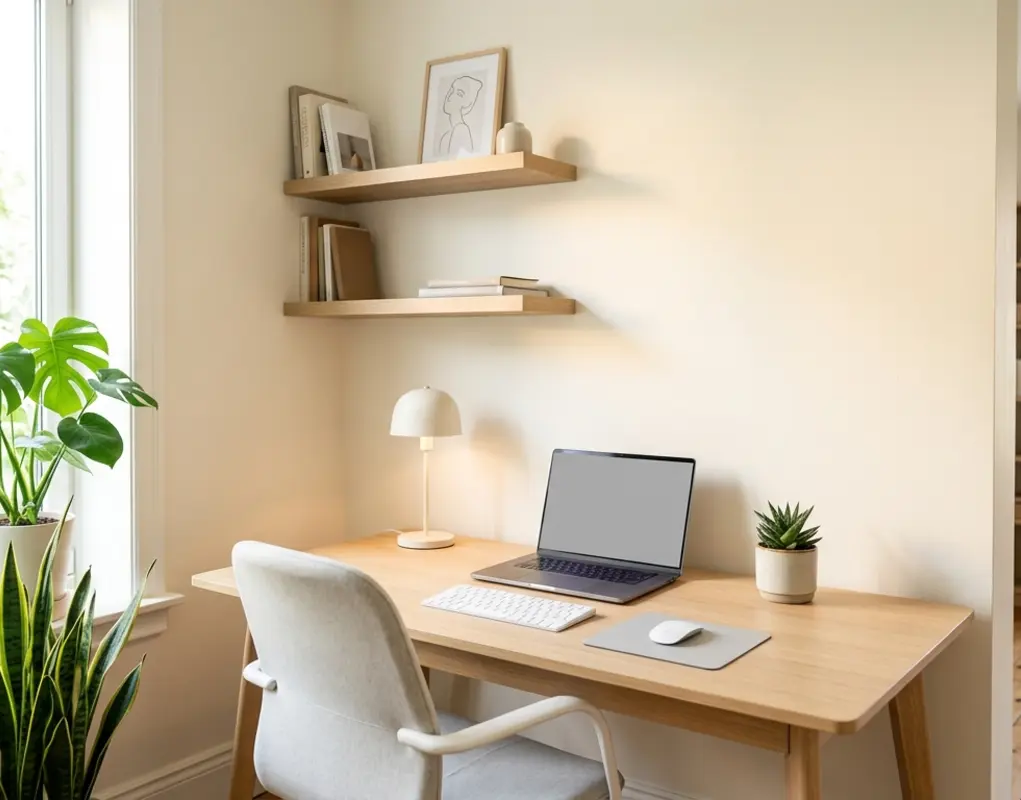
The reason light wall colors make a small room feel larger isn’t a decorating myth — it’s straightforward physics. Lighter surfaces reflect more of the available light back into the room. That reflected light is part of what makes a space read as open rather than boxed in.
Soft white, warm white, pale gray, light beige — these shades work well in compact offices because they don’t absorb the light the room is trying to use. A wall painted in a deep or saturated color generally absorbs more light and can create visual weight that makes the room feel smaller even when nothing else has changed.
This doesn’t mean the office has to look clinical or empty. A warm neutral — cream, greige, soft taupe — adds enough personality to feel intentional without the visual heaviness of a stronger color. If the office gets good natural light, there’s more flexibility. If it’s a darker room, lighter walls aren’t optional so much as essential.
2. Use Warm Neutrals Rather Than Pure White
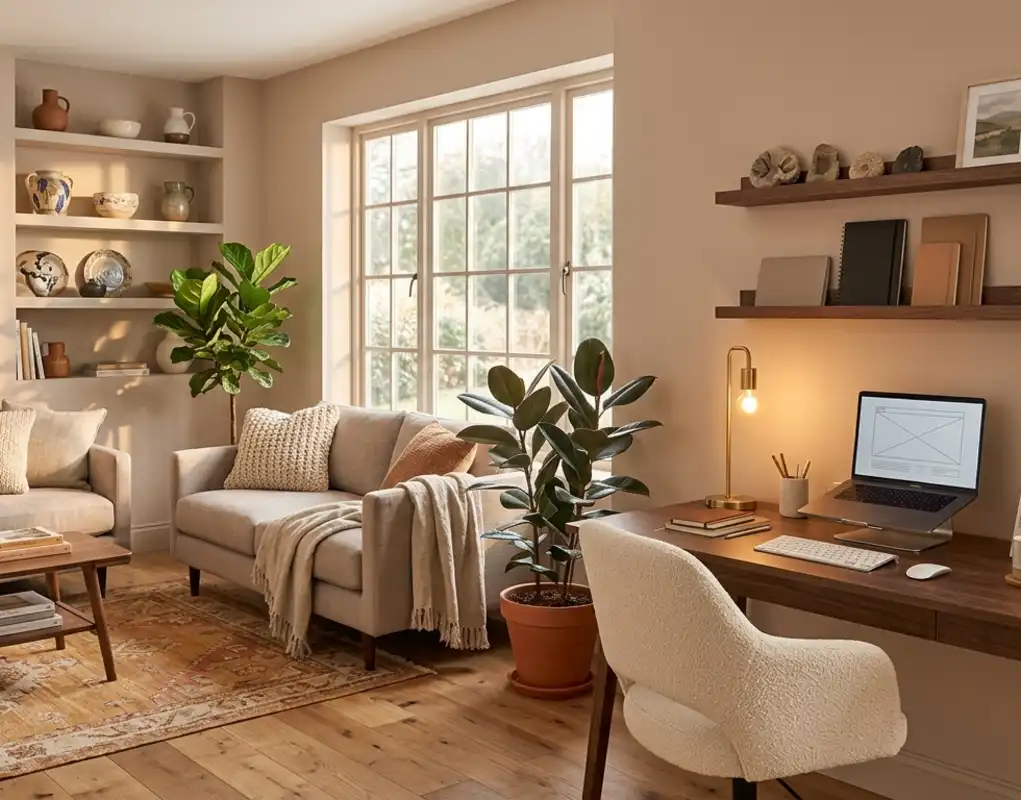
Pure white has a reputation as the go-to choice for small spaces, and it works — but it isn’t the only option, and it’s not always the best one.
A stark white in a room with cool light can feel cold rather than spacious. Warm neutrals — cream, soft beige, light greige, off-white with a yellow or pink undertone — tend to feel more comfortable while still keeping the room bright. They also tend to work better in offices that share space with a bedroom or living room, because a warm neutral reads as part of the room rather than as a separate office dropped into a corner.
The practical advantage of warm neutrals over white is that they’re more forgiving. They work with a wider range of furniture colors, they look better in artificial light, and they tend to age better than a pure white that yellows unevenly over time.
3. Think About the Visual Weight of Your Furniture
Wall color gets most of the attention in conversations about small spaces, but a dark desk, dark shelving, and dark chair against light walls can still make a room feel heavy. The wall color does its job and the furniture undoes it.
Lighter furniture finishes — natural wood, light oak, white, soft gray — reduce visual weight in a way that lets the room feel more open overall. This matters most for the largest pieces: the desk and any tall storage. A dark desk against dark shelving in a small room is often where things go wrong, regardless of what color the walls are.
If you already have dark furniture and don’t want to replace it, the answer isn’t necessarily to repaint everything. Lighter walls, a lighter chair, and reducing visual clutter around the desk — removing things from the desk surface, clearing the area immediately around it — can balance a dark desk without replacing it. For desk options worth considering, our guide to <a href=”https://buyfacto.com/5-best-small-desks-for-a-small-home-office/“>5 Best Small Desks for a Small Home Office</a> covers a range of sizes and finishes.
4. Use Dark Colors as Accents, Not Backgrounds
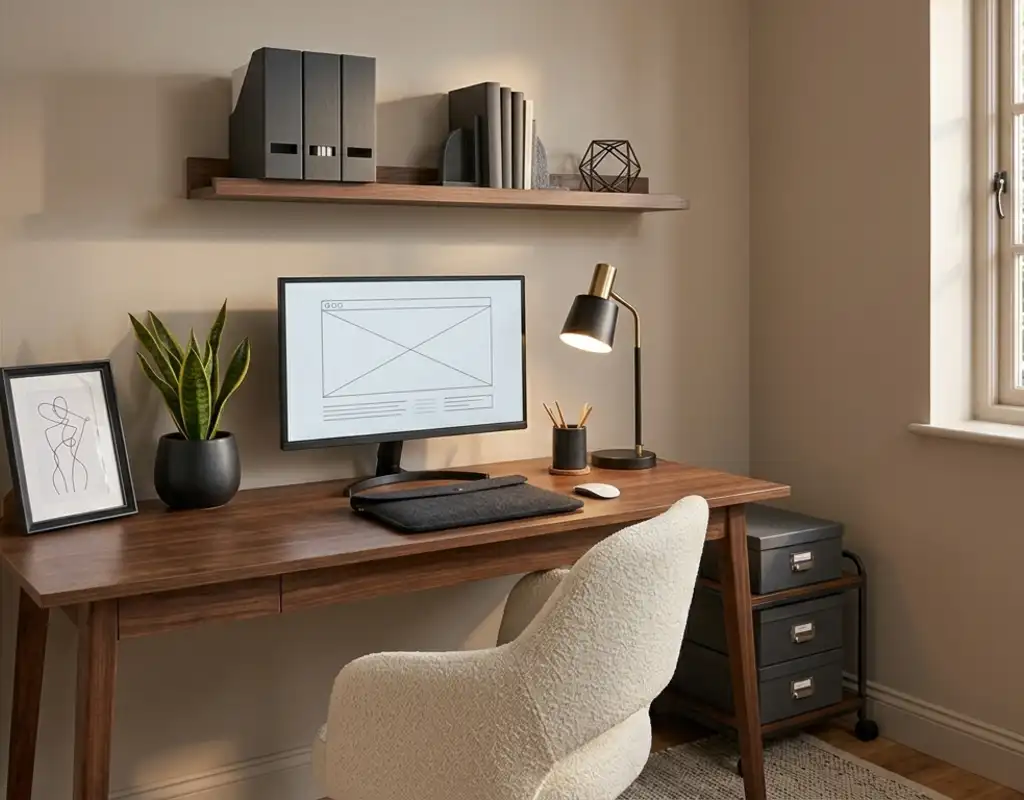
Avoiding dark colors entirely in a small office isn’t necessary — it just matters how much of the room gets them.
A single dark element against a lighter background creates depth and visual interest without making the room feel smaller. A black monitor frame, charcoal storage boxes, a dark picture frame, a deep-toned plant pot — these read as intentional contrast rather than visual weight. The light walls are still doing their job; the dark elements just stop the room from looking flat.
What tends not to work is covering the majority of the visual space in a small room with a dark color. A dark feature wall can work in a large room where there’s enough space for the eye to recover. In a small office, it usually just makes the room feel like a box.
5. Keep the Color Palette Simple
A home office already contains a lot of visual information: a desk, a monitor, a keyboard, a chair, cables, shelves, books, and whatever else accumulates on and around a workspace. Adding several competing colors on top of all that creates visual noise that makes the room feel busier than it actually is.
One main color — the walls — with two or three supporting shades works better than trying to introduce more variety. For example: light walls, natural wood desk, black or charcoal accessories, a small plant. Or: soft white walls, light gray storage, warm wood accents, one muted color introduced through the chair or a print. The room has personality without competing against itself.
The simplest version of this principle is to pick the wall color first and let everything else work around it, rather than trying to coordinate multiple strong colors simultaneously.
6. Think About How Your Desk Color Reads in the Room
The desk is usually the largest single object in a home office, which means its color has more effect on how the room feels than most people account for.
A desk that’s significantly different in tone from the walls tends to become the visual focal point of the room, whether that’s intended or not. In a small space, that can be overwhelming — the eye goes straight to the desk and doesn’t have room to settle anywhere else.
Light wood works well here because it’s warm enough to feel comfortable but doesn’t create the visual weight of dark wood or a strongly colored finish. It blends into a room without disappearing. If the preference is for a darker desk, keeping the walls and surrounding area simple gives it room to work without dominating the space.
7. Use Color to Define the Work Area
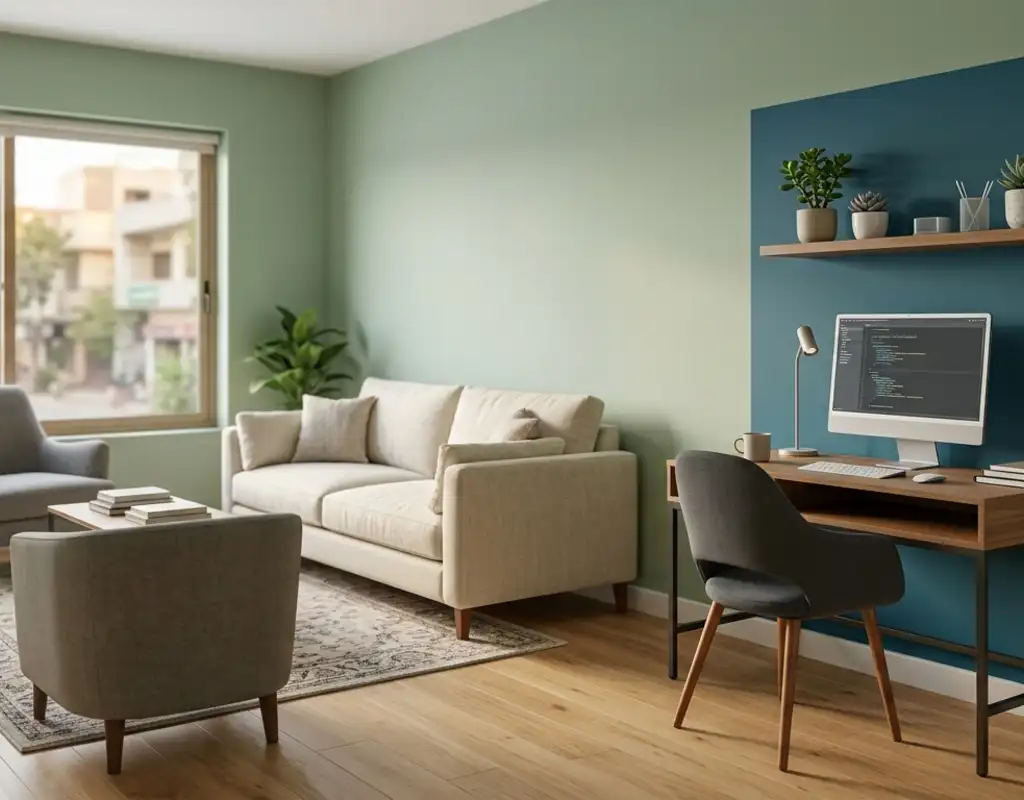
If the office is part of another room — a desk in a bedroom corner, a workspace at one end of a living room — color can do some of the work of separating the areas without needing a physical divider.
This doesn’t require painting the whole room. A slightly different shade on the wall directly behind the desk, a consistent accent color through the chair and desk accessories, or even just keeping the desk area noticeably cleaner and more minimal than the rest of the room creates a visual cue that this part of the room functions differently.
The difference doesn’t need to be dramatic to be effective. A subtle shift in tone or a consistent set of colors in the work area is enough to make the brain register a transition. For more ideas on making one room work for multiple purposes, our guide on <a href=”https://buyfacto.com/how-to-organize-a-small-room-that-serves-more-than-one-purpose/“>How to Organize a Small Room That Serves More Than One Purpose</a> covers the layout side of this.
8. Add a Plant or Two for Natural Color
Plants solve a specific problem in a small office: they add color and life to a space without adding visual clutter. A small plant on a shelf or at the corner of a desk introduces green in a way that reads as organic rather than decorative, which tends to feel less busy than adding more objects.
Green also happens to work particularly well with the neutral and light-wood combinations that tend to look best in small offices. It doesn’t compete with anything; it just adds something that feels alive.
One or two plants is usually enough. More than that in a small space starts to feel like a collection, which creates its own visual weight. If the desk is already crowded, a shelf or the top of a storage unit is a better location than the desk surface itself.
9. Don’t Forget the Ceiling and Trim
Most color decisions in a small office focus on the walls and furniture, and the ceiling and trim get ignored. In a small room, they matter more than in a larger one.
A ceiling painted the same color as the walls, or a shade lighter, removes the visual line where wall meets ceiling and can help the room feel slightly taller. White or soft neutral trim creates a clean transition between surfaces and stops the walls from feeling like they end abruptly.
None of this needs to be complicated. The simplest version — ceiling white or slightly lighter than the walls, trim white or matching — does most of the work. The main thing to avoid is strong contrasts between the ceiling, walls, and trim in a very small room, which can make the space feel chopped up rather than cohesive.
10. Check Colors at Different Times of Day
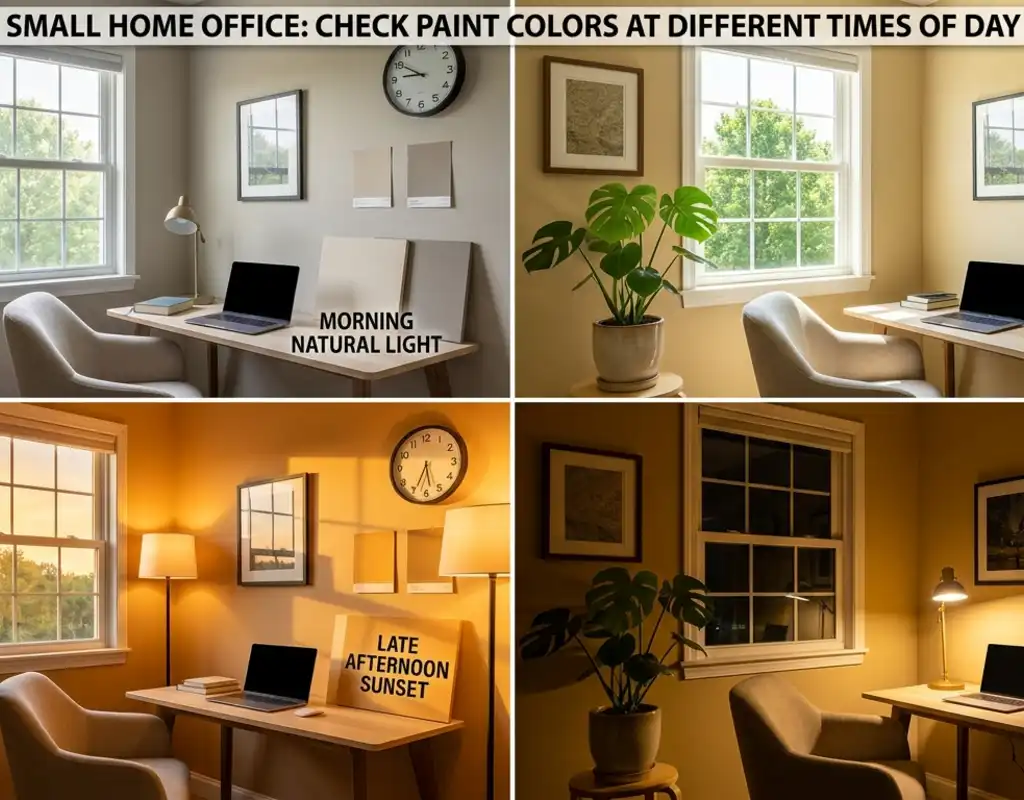
Paint colors look different in natural daylight than they do under artificial light, and both of those can look different again in the evening. A warm beige that looks perfect at noon can look orange under certain LEDs. A gray that reads as cool and calm in daylight can look purple in lamplight.
This is why testing paint samples on the actual wall — not just looking at a small chip in a showroom — matters. Taping a large sample to the wall and checking it at different times of the day before committing saves the frustration of repainting.
The same applies to how the lighting itself affects the room. Color and lighting work together, and getting one right while ignoring the other means only solving half the problem. Our guide to <a href=”https://buyfacto.com/small-home-office-lighting-ideas-how-to-brighten-a-small-workspace/“>Small Home Office Lighting Ideas: How to Brighten a Small Workspace</a> covers the lighting side of this in more detail.
Frequently Asked Questions
What is the best color for a small home office?
Light neutrals — soft white, warm white, pale gray, beige, and light greige — tend to work best because they reflect more available light and reduce the visual weight of the walls. The specific shade matters less than avoiding anything too dark or too saturated.
Does a small home office have to be white?
No. White works, but warm neutrals often work better — particularly in rooms with cooler artificial light, or where the office shares space with a bedroom or living area. A warm off-white or light beige tends to feel more comfortable than a stark white while still keeping the room bright.
Can dark colors work in a small home office?
Yes, as accents. A dark desk, dark accessories, or a small dark element against lighter walls adds depth without making the room feel smaller. Covering most of the visual space in a small room with a dark color tends to make it feel more enclosed rather than more interesting.
What furniture colors work best in a small office?
Lighter finishes — natural wood, light oak, white, soft gray — reduce visual weight and let the room feel more open. If you already have dark furniture, lighter walls and reducing surrounding clutter can balance it without replacement.
How many colors should a small home office have?
One main color with two or three supporting shades is usually enough. More than that in a small room tends to create visual noise rather than personality. The simplest version — light walls, natural wood, one accent color — is often the most effective.
Final Thoughts
Color does more work in a small home office than most people give it credit for. The right wall color reflects more light, reduces visual weight, and makes the room feel more open — all without changing a single piece of furniture.
Start with the walls. Choose something light enough to reflect available light but warm enough to feel comfortable rather than clinical. Think about the visual weight of the desk and storage, and whether they’re working with or against the walls. Keep the overall palette simple enough that the room doesn’t feel busy before you’ve even sat down.
Check everything at different times of day before committing, and remember that color and lighting are connected — improving one while ignoring the other only solves part of the problem.
For more practical ideas on making a compact workspace function well, explore our <a href=”https://buyfacto.com/category/small-home-office/“>Small Home Office</a> guides.