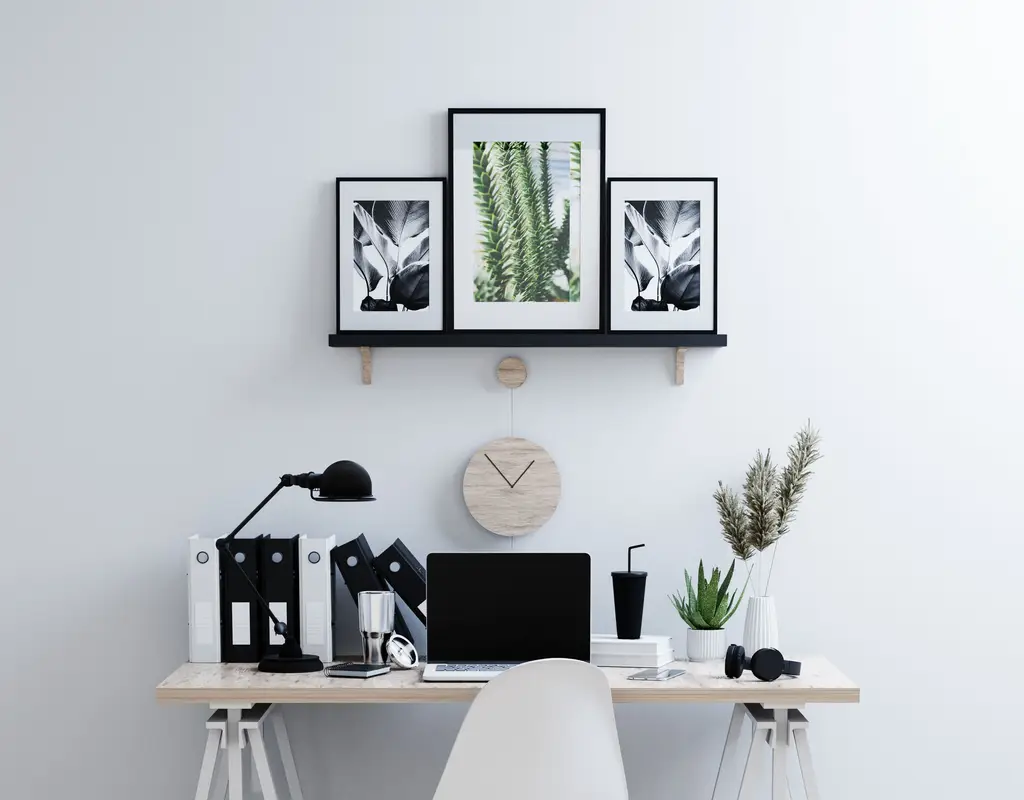
An empty wall in a small office feels unfinished. A wall with too much on it feels like the room shrank. Somewhere between those two is the actual goal — a space that looks like someone lives and works there, without every inch of vertical surface competing for attention.
This isn’t about wall color or functional storage — our Color Ideas guide covers paint, and our Storage Ideas guide covers shelves built to hold things. This is specifically about decor — art, photos, and personal objects that exist to make the room feel like yours rather than to hold or organize anything.
Pick One Wall to Be the Focal Point
A small office usually has less wall space to work with than it seems, once you subtract the space taken up by the door, the window, and the desk itself. Trying to decorate every remaining wall segment tends to spread the room’s visual attention too thin, so nothing actually stands out.
Choosing a single wall — usually the one most visible from the doorway, or the one directly behind or beside the desk — to be the main decorated surface gives the eye somewhere to land. The other walls can stay mostly bare or hold just one small piece, which reads as intentional restraint rather than an unfinished room.
Match the Frame Density to the Room’s Size
A gallery wall with a dozen small frames looks striking in a spacious room with high ceilings. In a small office, the same approach usually reads as busy, because there’s less negative space around it to let it breathe.
A tighter cluster of a few pieces, sized a bit larger than you might first choose, tends to hold up better in a small room than many tiny frames scattered across the wall. Fewer, slightly bigger pieces give the eye fewer separate points to process, which keeps the wall feeling considered rather than cluttered.
Let Personal Items Do Double Duty
Decor doesn’t have to mean art bought specifically to fill wall space. A small office is often the one room where genuinely personal objects — a certificate, a favorite photo, a piece of art you already owned — fit naturally, since it’s a space you’re in for hours at a time and one that visitors rarely wander into uninvited.
Using items you already have, rather than buying new pieces specifically for the wall, tends to produce a more personal-feeling room and avoids adding new physical objects to a space that’s already working with limited storage. If something needs a shelf rather than wall mounting, that’s a cue it may belong in a different category — worth checking against our Storage Ideas guide rather than crowding the decorated wall.
Keep Decor Off the Wall Behind Your Video Calls
The wall visible behind you on a video call functions differently than the rest of the room’s walls — it’s on display to other people, often repeatedly, in a way no other wall in the house is. Overly busy decor there can be distracting on camera, and certain patterns or bright colors can visually interfere with video compression, making the image look worse than it needs to.
A calmer background — a single piece of art, a plant, or a mostly clean wall — tends to look better on camera than a fuller gallery wall would, even if that fuller wall would look great in person from across the room. If your camera faces a window rather than a wall, that’s a separate issue our Window Ideas guide covers in more depth.
Use Vertical Height, Not Just Wall Width
Small rooms often have more unused vertical space than horizontal space, since furniture eats into width but rarely reaches the ceiling. Hanging one piece slightly higher than you might normally expect can draw the eye upward and make the room’s proportions feel taller than they are.
This works especially well paired with a single larger piece rather than a horizontal row of smaller ones, since a tall, vertically oriented piece emphasizes the room’s height rather than repeating its width back at you.
Leave Room for the Wall to Change
A wall completely filled with permanently mounted frames is hard to update without a fresh set of nail holes. Leaving a little breathing room — an open picture ledge, a single nail with a rotating piece, or one section left intentionally bare — makes it easier to swap things out as your taste or the season changes, without redoing the whole wall each time.
This also helps the space from feeling frozen in time. A small office you sit in every day benefits from occasionally noticing something new on the wall, even if it’s just a photo swapped out for a different one.
Frequently Asked Questions
How much wall art is too much for a small office?
If you find yourself running out of matching frame sizes or filling every remaining gap just because it’s empty, that’s usually a sign to stop. A good check is whether you can name what each piece is without looking closely — if the wall has become a blur of frames, it’s past the point of being effective decor.
Should I decorate the wall behind my desk or the wall I see while working?
Both have a place, but they serve different purposes. The wall behind you affects how the room looks on video calls and to anyone entering the room. The wall in front of you is what you actually look at all day, so it’s worth being more selective there — something calming or motivating rather than visually busy, since you’ll be looking at it for hours.
Is it better to buy new art or use things I already own?
Using things you already own usually works better in a small office specifically, since it doesn’t add new physical objects to a space with limited storage, and personal items tend to make a small, frequently used room feel more like yours than generic purchased art does.
What wall decor works best for video calls?
A single calm piece, a plant, or a mostly clean wall tends to look better on camera than a busy gallery wall, since cameras compress detail and can make patterned or cluttered backgrounds look distracting rather than personal.
How do I decorate a small office without it feeling cluttered?
Pick one wall as the main focal point rather than decorating every surface, use fewer and slightly larger pieces instead of many small ones, and leave at least a little empty space around whatever you hang. Restraint tends to read as intentional design, while filling every gap tends to read as clutter.
Final Thoughts
Wall decor in a small office works best when it’s treated as a deliberate, limited choice rather than something to fill every available gap. One focal wall, a handful of pieces sized to the room, and a little visible breathing room around them usually does more for how personal and put-together the space feels than covering every surface would.
The goal isn’t a bare room or a gallery wall — it’s a small number of things on the wall that actually mean something to you, positioned where you’ll notice them.