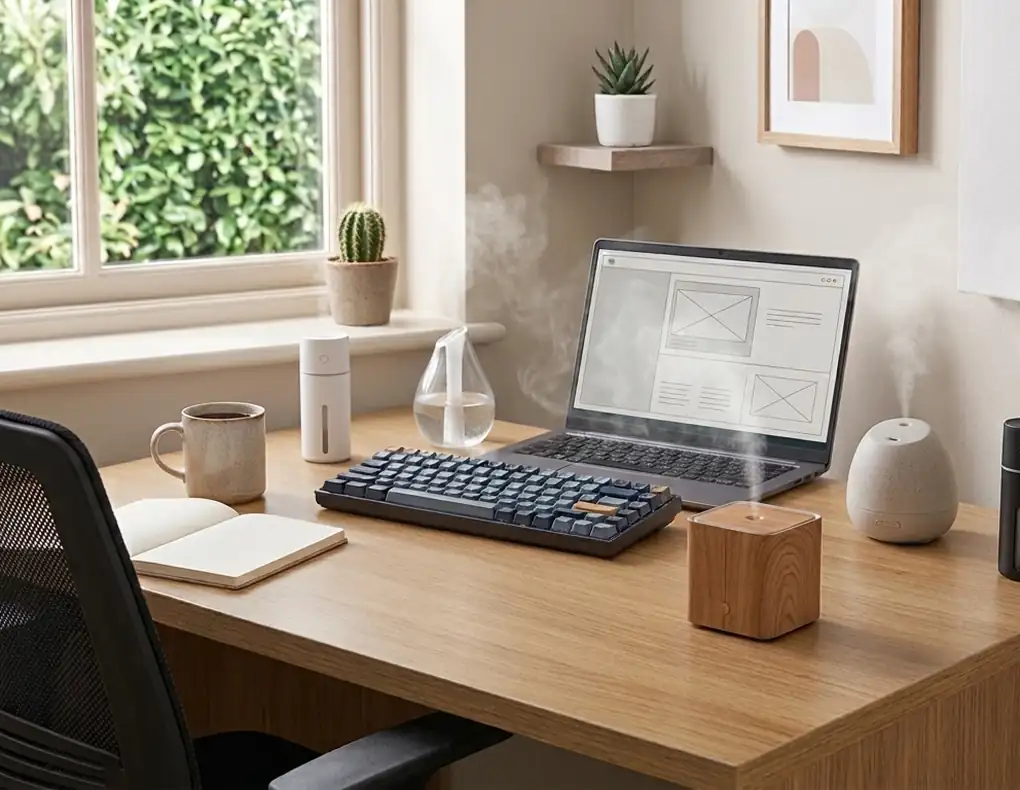
The best compact humidifiers for small home offices can help add moisture to a workspace when indoor air feels too dry. This can happen during colder weather, when heating runs frequently, or when indoor conditions change throughout the day.
A compact humidifier can provide moisture without taking up the floor space of a larger appliance. In a small office, however, choosing the right model involves more than finding the smallest unit available.
The humidifier should fit the available space, suit the room size, operate at a comfortable noise level, and remain easy to refill and clean. A model that is difficult to maintain or poorly suited to the room can quickly become inconvenient.
This guide compares five compact humidifier designs for smaller home offices and explains the features that can help you compare them before buying.
Affiliate Disclosure: Some links on Buy Facto may be affiliate links. If you purchase through one of these links, we may earn a commission at no additional cost to you.
Amazon Associates Disclosure: As an Amazon Associate I earn from qualifying purchases.
What Makes the Best Compact Humidifiers for Small Home Offices?
The right humidifier should fit both the physical space and the conditions of the room.
A product can have a very small footprint but still be unsuitable if its output is too limited for the room or if its tank needs constant refilling.
Before buying, look at these factors:
Size and Footprint
Measure the surface where you plan to place the unit.
Leave enough surrounding space for safe operation and maintenance. A humidifier should not be squeezed between a monitor, keyboard, paperwork, and other desk equipment.
Room Coverage
Check the manufacturer’s recommended coverage area rather than assuming that a compact design will work for every room.
A personal USB model may be intended for a very small area, while a larger compact unit may be designed for a whole room or larger workspace.
Tank Capacity
Tank size affects how often you need to refill the humidifier.
A smaller tank can make the unit easier to carry and clean. A larger tank may reduce refill frequency but can require more space.
Mist or Moisture Output
The amount of moisture produced matters just as much as the physical size of the appliance.
Look for the manufacturer’s output information and make sure it is appropriate for your room.
Noise
If your office is used for concentrated work or online meetings, background noise can matter.
Manufacturer noise specifications can be more useful than relying on a general “quiet” label.
Controls and Humidistat
Basic models may only offer a few output settings. More advanced compact humidifiers may include a built-in humidistat that helps control the target humidity level.
A humidity meter can also help you understand the actual conditions in the room.
EPA recommends keeping indoor relative humidity between 30 and 50 percent and using a humidity gauge to monitor it.
Cleaning Access
Water-contact parts need regular cleaning. Look for a tank opening that is easy to reach and removable components that can be maintained according to the manufacturer’s instructions.
Automatic Shutoff
Automatic shutoff can stop the unit when the water level becomes too low. It is a useful convenience feature, especially if you do not want to monitor the tank constantly.
1. Compact Ultrasonic Humidifier
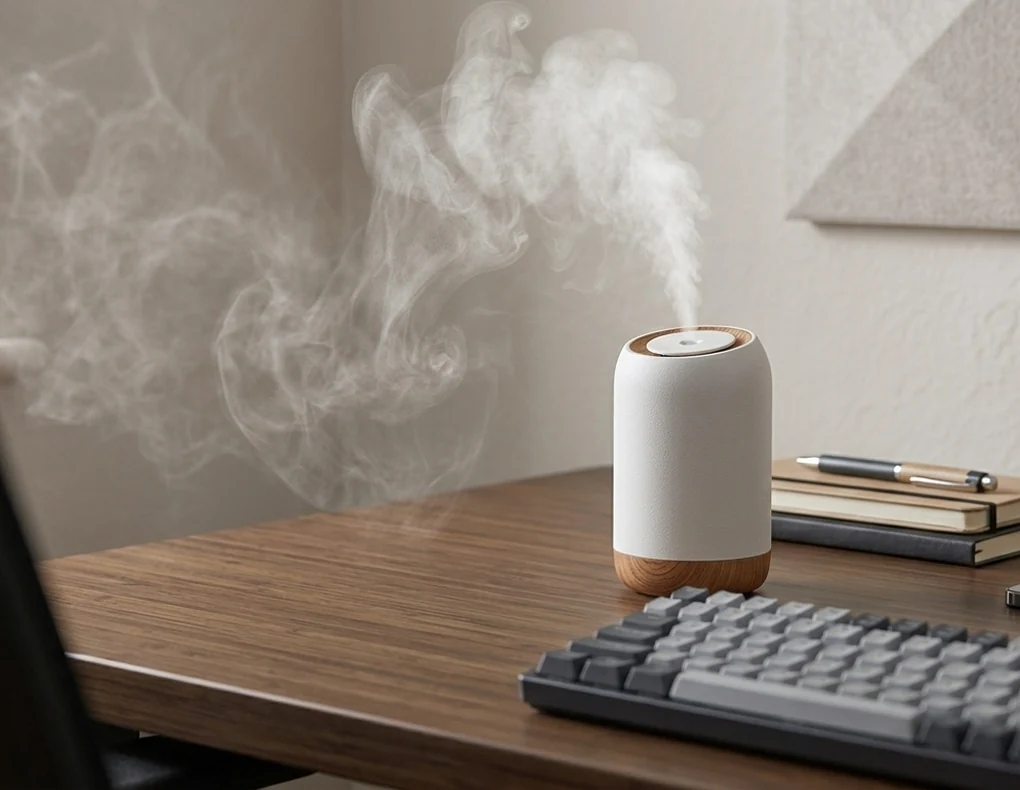
A compact ultrasonic humidifier is one of the most common designs for smaller spaces.
Instead of boiling water, ultrasonic models use high-frequency vibrations to create a cool mist. Their compact form can make them convenient for a small office where available floor or desk space is limited.
This type may suit a workspace where you want:
- A relatively small footprint
- Adjustable mist output
- Cool-mist operation
- Easy movement between suitable locations
- Simple electronic controls
What to Watch For
Ultrasonic humidifiers can disperse minerals from the water into the surrounding air. EPA recommends using water with lower mineral content, such as distilled water, to reduce this issue.
The unit also needs careful placement. Keep the mist away from computers, monitors, paperwork, electrical outlets, and other surfaces that should remain dry.
A compact ultrasonic model can be convenient, but its maintenance requirements and water quality considerations should be part of the buying decision.
2. Mini USB Humidifier
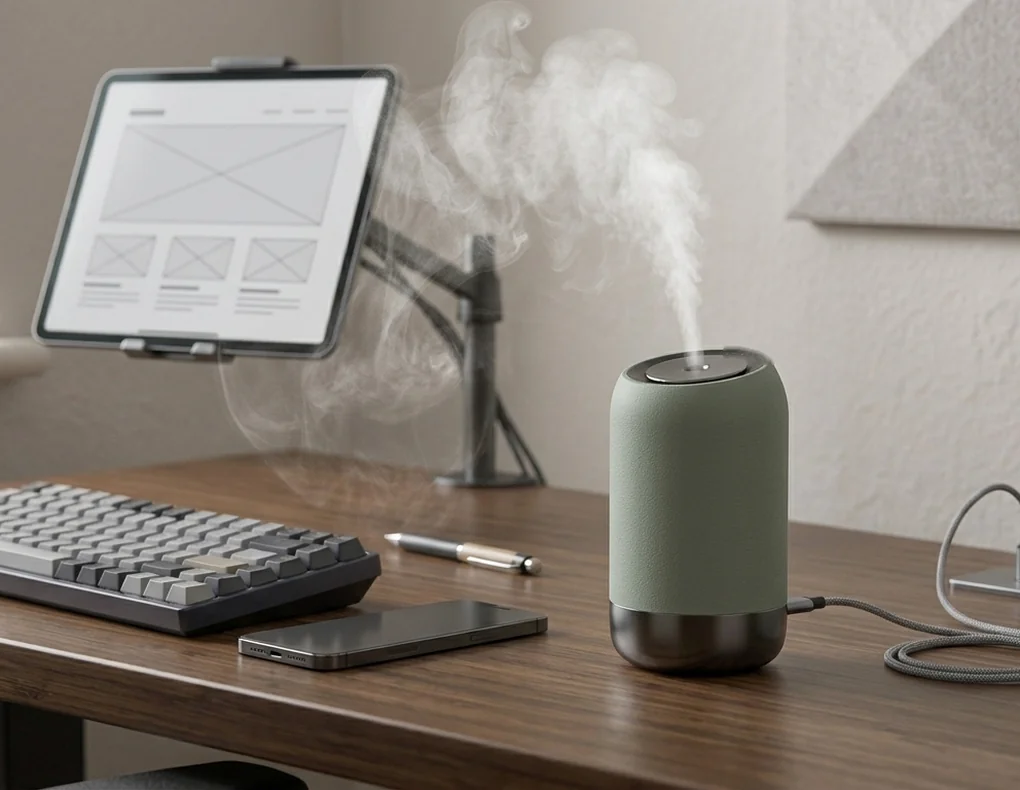
A mini USB humidifier focuses on portability and minimal space requirements.
These small units can be useful when you have a very limited work area and want something designed for personal use rather than high-output room humidification.
A USB-powered design may also be convenient for a flexible workspace because it can use a compatible USB power source instead of depending on a fixed installation location.
When This Option Makes Sense
A mini USB humidifier may be worth considering when:
- Desk space is extremely limited
- Portability matters
- You move between different work areas
- You prefer a simple control system
- Your intended use is personal rather than whole-room
Check the Intended Coverage
The main limitation of a tiny humidifier is also its biggest advantage: its size.
A small personal unit should not automatically be expected to change the humidity throughout an entire room.
Always check the manufacturer’s intended coverage, runtime, water capacity, and output before buying.
3. Compact Evaporative Humidifier
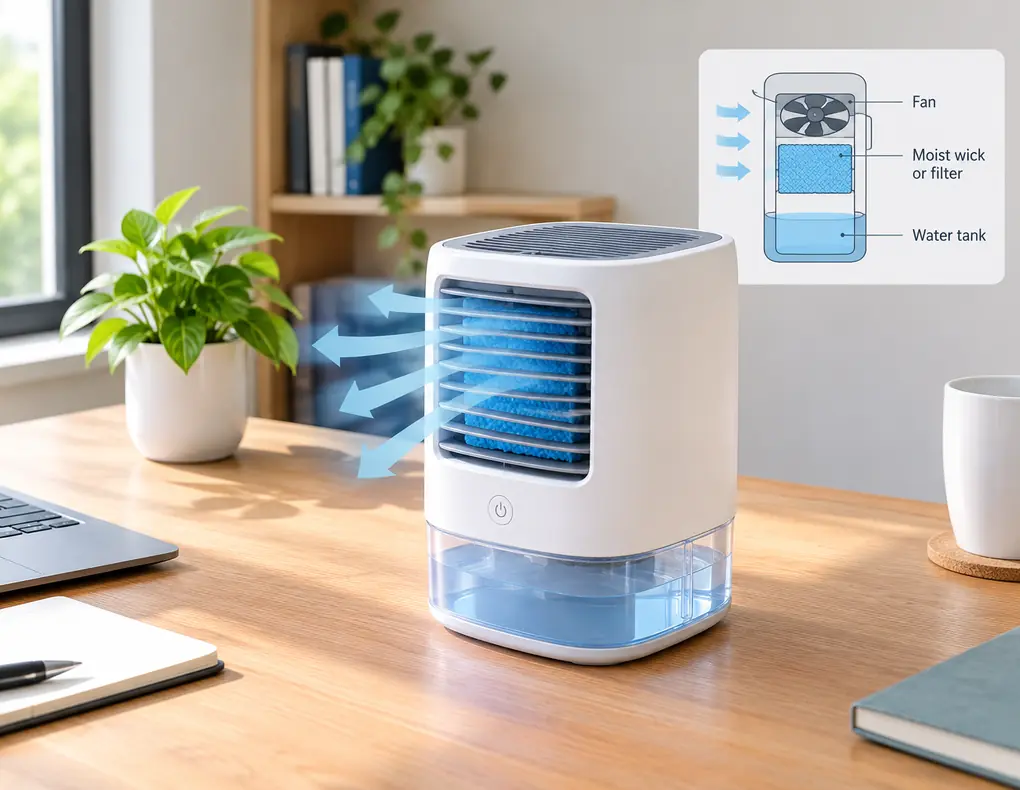
A compact evaporative humidifier uses a different approach from an ultrasonic model.
Instead of producing a visible mist directly, an evaporative design generally uses a fan to move air through a moistened wick, filter, or other absorbent material. EPA identifies evaporative humidifiers as a portable humidifier type and notes that they generally do not disperse substantial amounts of minerals into the air.
This can make an evaporative model interesting for buyers who want a compact design but would rather avoid the visible mist associated with many ultrasonic units.
Things to Check
An evaporative model can have different maintenance needs because of its wick or filter.
Before buying, check:
- Replacement filter requirements
- Filter cost
- Tank capacity
- Fan noise
- Recommended room size
- Access to the water reservoir
- Operating time
The filter is an important part of the ownership cost, so a low purchase price does not necessarily mean the lowest long-term cost.
4. Compact Top-Fill Humidifier
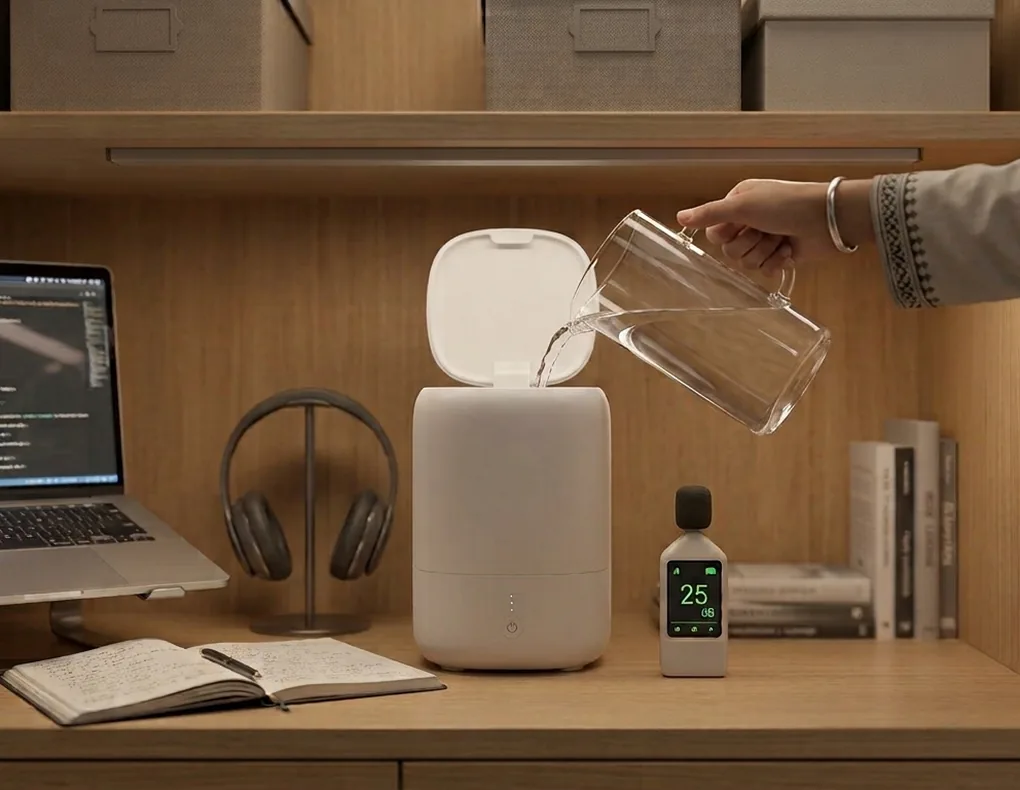
A top-fill humidifier is mainly about making everyday refilling easier.
With this design, water is added through an opening at the top of the unit. That can be convenient when the humidifier remains in one location and you do not want to turn it over or remove a difficult-to-access reservoir every time you need to add water.
Why Refill Design Matters
A humidifier may have excellent specifications, but an inconvenient refill process can make daily use frustrating.
A compact top-fill model can be useful when:
- The unit stays near your workstation
- You refill it frequently
- You want easy access to the tank
- You prefer a straightforward setup
- The available surface is stable and easy to reach
Top-Fill Does Not Mean Maintenance-Free
Before buying, look inside the tank opening if product photos or specifications allow.
Check whether you can comfortably reach the water-contact surfaces and whether the manufacturer’s cleaning instructions are practical.
The easiest humidifier to maintain is often the one that gives you simple access to the areas that need regular attention.
5. Compact Humidifier With Built-In Humidistat
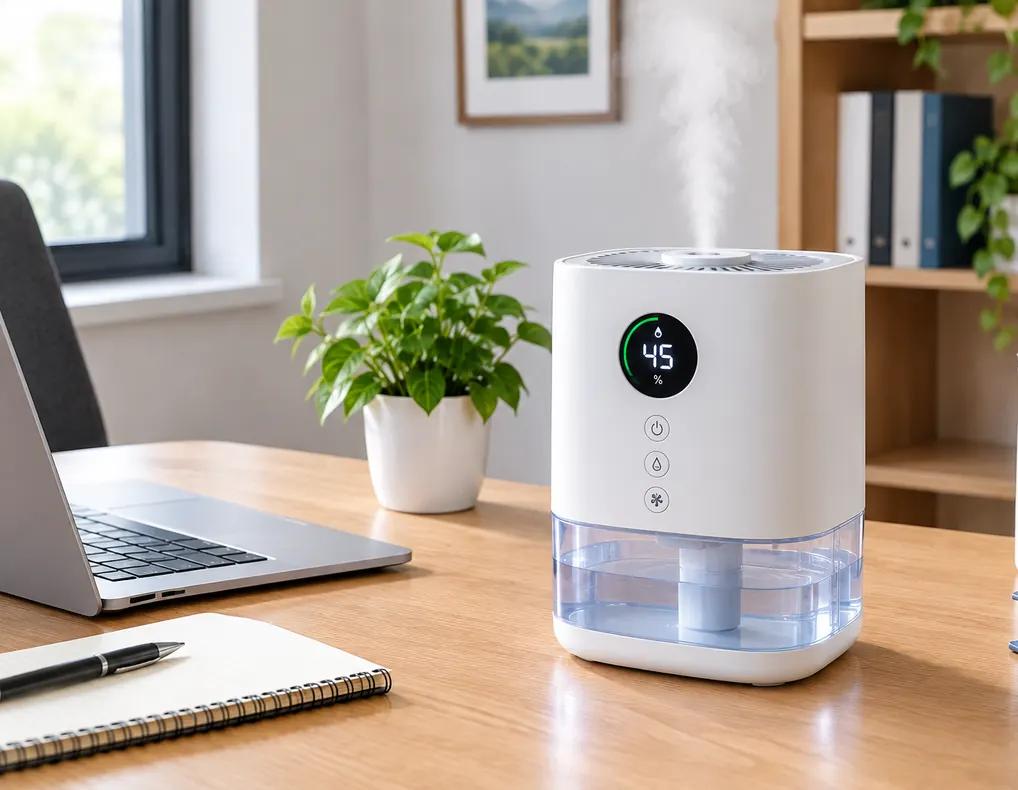
A compact humidifier with a built-in humidistat gives you more control over the moisture level than a basic manual model.
Instead of simply selecting a mist setting and leaving the unit to run, a humidistat can help manage operation according to the humidity level detected by the appliance.
This can be useful in a small office because the room conditions may change throughout the day.
Features Worth Comparing
Look for:
- Adjustable humidity settings
- Multiple output levels
- Automatic shutoff
- Easy-to-read controls
- Water-level visibility
- Accessible tank
- Straightforward cleaning instructions
The goal should be controlled humidification rather than maximum moisture output.
EPA advises not to humidify indoor spaces above 50 percent relative humidity and recommends reducing output or changing the humidifier’s use if condensation develops on windows, walls, or pictures.
How Much Humidity Does a Small Home Office Need?
Before switching on a humidifier, it helps to know the actual humidity level in the room.
Many people judge humidity only by how the air feels, but a small hygrometer can provide a more useful measurement.
EPA recommends maintaining indoor relative humidity between 30 and 50 percent.
This matters because adding too much moisture can create a different problem.
If condensation begins appearing on windows, walls, pictures, or nearby surfaces, EPA recommends relocating the humidifier, lowering the humidistat setting, or reducing its use. The area around the humidifier should also remain dry rather than becoming damp.
For a small office, controlled output is usually more useful than simply choosing the highest-capacity model available.
Where Should You Put a Compact Humidifier?
Placement becomes especially important when a workspace is small.
A compact humidifier may sit close to electronics, documents, cables, or other items simply because everything is within arm’s reach.
Choose a stable, level surface with enough room around the appliance.
Avoid placing the unit:
- Directly beside a laptop
- Next to a monitor
- Above electrical equipment
- Beside important paperwork
- On a crowded or unstable surface
- Where spilled water could reach cables or outlets
- Where mist can settle continuously on nearby objects
Do not aim the moisture toward electronics or other items that should remain dry.
A nearby side table can sometimes provide a more practical location than the main desk, especially when the desk already holds a monitor, keyboard, speakers, and other work equipment.
For more ideas on arranging a compact workstation, see our Small Home Office Layout Ideas.
How Do You Choose the Right Size?
Physical dimensions and humidification capacity are two different things.
A humidifier can be small enough to fit on a desk but still be intended for a particular room size. Another model may have a larger tank and higher output while still being relatively compact compared with a full-size household appliance.
When comparing models, look at:
- Product dimensions
- Recommended room area
- Moisture output
- Water tank capacity
- Expected runtime
- Placement requirements
Do not choose based on height or width alone.
The best match is the smallest practical model that still meets the manufacturer’s stated requirements for the space.
Tank Size vs. Runtime
Tank capacity tells you how much water the appliance can hold, but it does not tell you exactly how long the humidifier will operate.
Runtime can change according to output level and product design.
A compact model with a small tank may need frequent refilling if used at a higher setting. A unit with a larger reservoir may run longer between refills but may also take up more space.
For a home office, think about your normal routine.
If you only use a humidifier for short periods, a smaller tank may be perfectly practical. If you prefer longer sessions with fewer interruptions, a larger reservoir may be more convenient.
Humidifier vs. Dehumidifier
A humidifier and a dehumidifier perform opposite functions.
A humidifier adds moisture to the air, while a dehumidifier removes moisture.
That distinction is important when choosing an appliance for a small home office.
If the room feels too dry and humidity readings are low, a humidifier may be relevant.
If the room already has excessive moisture or humidity, adding more moisture would not address the problem.
Our guide to Best Compact Dehumidifiers for Small Home Offices covers the opposite type of appliance, including water removal, tank capacity, drainage, and compact placement.
Humidifier vs. Air Purifier
A humidifier does not perform the same job as an air purifier.
A humidifier changes the moisture level of indoor air, while an air purifier is designed to remove or reduce certain airborne particles depending on its filtration system.
The two appliances should therefore be compared according to the problem you are trying to address.
Dry indoor air calls for a different approach from concerns about particle filtration.
You can learn more about compact air-cleaning products in our guide to Best Compact Air Purifiers for Small Home Offices.
How to Keep a Compact Humidifier Clean
Maintenance is one of the most important parts of humidifier ownership.
For more information about using and maintaining portable humidifiers, see the EPA Guide to Using and Caring for Home Humidifiers.
A tank that repeatedly holds water needs regular attention, and the exact cleaning procedure depends on the design and the manufacturer’s instructions.
EPA’s humidifier guidance recommends emptying portable humidifier tanks, drying the surfaces, and refilling them with fresh water daily. EPA also recommends cleaning portable humidifiers regularly, including every third day in its use-and-care guidance, to reduce scale and microorganism buildup.
A practical maintenance routine should include:
Empty Old Water
Do not leave unused water sitting in the tank longer than the manufacturer’s instructions allow.
Wipe the Tank
After emptying the unit, wipe or dry the appropriate surfaces as directed by the manufacturer.
Remove Mineral Deposits
Mineral deposits can build up inside the tank, particularly when water contains more dissolved minerals.
EPA recommends water with low mineral content, such as distilled water, for reducing mineral dispersal from humidifiers.
Clean Water-Contact Areas
Clean the tank and other water-contact surfaces according to the manufacturer’s maintenance instructions.
Replace Filters or Cartridges
Evaporative humidifiers and some other designs may use replaceable filters, wicks, cartridges, or similar components.
Check replacement intervals and costs before buying.
Is Distilled Water Necessary?
Water requirements depend on the humidifier design and the manufacturer’s instructions.
EPA recommends using water with lower mineral content, such as distilled water, to reduce mineral release into indoor air. This is particularly relevant for ultrasonic and impeller or cool-mist humidifiers.
Using lower-mineral water can also reduce the amount of scale that forms inside some humidifiers.
Before purchasing a model, check the instructions to see whether it recommends distilled water, demineralized water, tap water, or a specific cartridge or filter.
What About Warm-Mist or Steam Humidifiers?
Warm-mist and steam humidifiers work differently from cool-mist ultrasonic models.
Steam vaporizers heat water to produce steam, while warm-mist humidifiers cool the steam before it exits the unit.
This type can be considered when you prefer a heated-moisture design, but it may not be the most convenient choice for every small home office.
Steam and hot water create a burn hazard, so the appliance needs to be placed where people cannot accidentally knock it over or come into contact with hot water or steam. EPA specifically warns about this risk with steam vaporizer humidifiers.
For a compact office, carefully consider placement, operating style, and safety requirements before choosing a warm-mist or steam model.
How Much Does Maintenance Cost?
The purchase price is only one part of the cost of owning a humidifier.
Depending on the design, you may eventually need:
- Replacement filters
- Wicks
- Demineralization cartridges
- Cleaning supplies
- Replacement parts
This is especially worth checking for evaporative models and products that use replaceable water-treatment components.
A slightly more expensive humidifier may have lower ongoing maintenance needs, while a cheaper model may require more frequent consumables.
Compare the complete ownership routine rather than the product price alone.
Common Mistakes to Avoid
Buying the Smallest Unit Without Checking Coverage
A tiny humidifier may fit your desk perfectly but still be too limited for the room.
Check the manufacturer’s recommended area before buying.
Using It Without Measuring Humidity
Guessing can lead to unnecessary operation or excessive moisture.
A simple hygrometer can show the actual humidity level.
Placing It Too Close to Electronics
Small offices have limited space, so it is easy to place the humidifier too close to monitors, laptops, printers, and cables.
Keep moisture away from sensitive equipment.
Ignoring the Tank and Cleaning Routine
Regular maintenance is part of using a humidifier. A difficult-to-clean design may become inconvenient over time.
Choosing a Model With Expensive Replacement Parts
Check filter, wick, or cartridge requirements before deciding.
Running Maximum Output Continuously
More moisture is not automatically better. EPA recommends keeping indoor relative humidity at or below 50 percent and reducing humidifier use when excessive dampness or condensation appears.
Treating a Humidifier as an Air Purifier
These appliances serve different purposes. Choose according to the actual need in your workspace.
Quick Buying Checklist
Before choosing a compact humidifier for your home office, check:
- Product footprint
- Recommended room coverage
- Moisture output
- Water tank capacity
- Expected runtime
- Noise information
- Mist or moisture-control settings
- Built-in humidistat, if needed
- Automatic shutoff
- Tank access
- Cleaning requirements
- Water-quality recommendations
- Replacement filter or cartridge costs
- Safe placement requirements
- Manufacturer instructions
This checklist can make it easier to compare several compact models without focusing only on appearance or price.
FAQs
Are compact humidifiers good for small home offices?
They can be useful when the room is appropriately sized for the humidifier and the indoor humidity is below a comfortable range. Check the manufacturer’s coverage information and monitor the humidity rather than relying only on how the room feels.
Can I put a humidifier on my desk?
A humidifier can be placed on a suitable stable surface when the product is designed for that type of use. Keep it away from electronics, paperwork, cables, outlets, and other surfaces that should remain dry.
Are mini USB humidifiers suitable for an entire room?
Not necessarily. Many small USB models are intended for personal or limited-area use. Check the manufacturer’s stated coverage before expecting whole-room performance.
Is an ultrasonic humidifier better than an evaporative model?
They work differently, so the choice depends on what matters to you. Ultrasonic models can offer compact designs and cool mist, while evaporative models use a moistened wick or similar material with airflow. Compare maintenance, noise, coverage, water requirements, and replacement parts rather than choosing solely by type.
Is a top-fill humidifier easier to refill?
Top-fill designs are generally intended to make adding water more convenient, but the actual experience depends on the size of the opening, tank design, and cleaning access.
What humidity level should I keep in my home office?
EPA recommends keeping indoor relative humidity between 30 and 50 percent. A hygrometer can help you monitor the actual level.
How often should humidifier water be changed?
EPA recommends emptying portable humidifier tanks, drying them, and refilling with fresh water daily. Follow the product manufacturer’s instructions as well.
How often should a portable humidifier be cleaned?
EPA recommends regular cleaning and specifically states that portable humidifiers should be cleaned every third day in its use-and-care guidance. The manufacturer’s instructions should also be followed.
Should I use distilled water?
EPA recommends water with lower mineral content, such as distilled water, to reduce mineral dispersal. Check your humidifier’s instructions because water requirements can vary by product.
Can I leave a humidifier running all day?
Not automatically. The appropriate operating time depends on the room, humidity level, humidifier output, settings, and manufacturer instructions. Monitor the humidity and reduce use if condensation or dampness appears.
Is a quiet humidifier important for a home office?
It can be. If you work in a quiet room or spend a lot of time on calls, check the manufacturer’s noise information and consider where the unit will be positioned.
Does a humidifier remove dust or airborne particles?
A humidifier is primarily intended to add moisture. It should not be treated as a replacement for an air purifier designed for particle filtration.
Final Thoughts
The best compact humidifiers for small home offices are not simply the smallest models you can find.
The right choice should fit the available space while providing appropriate moisture output for the room. It should also be practical to refill, simple enough to maintain, and easy to position away from electronics and paperwork.
A compact ultrasonic model can be attractive when small size and cool-mist operation are priorities. A mini USB design may suit a very limited personal workspace. An evaporative model offers a different moisture-delivery approach, while a top-fill design can make routine refilling more convenient. A model with a built-in humidistat can provide greater control when maintaining a specific humidity level matters.
Before buying, check the manufacturer’s room coverage, tank capacity, operating time, noise information, maintenance requirements, and water recommendations.
Just as importantly, measure the humidity rather than assuming that more moisture is always better. EPA recommends keeping indoor relative humidity between 30 and 50 percent and reducing humidifier use when excessive dampness or condensation appears.
With the right size, sensible placement, regular maintenance, and controlled output, a compact humidifier can fit into a small workspace without becoming another source of clutter.
For more ways to make a compact workspace practical, see our Small Home Office Desk Organization Ideas and browse the Small Home Office category.