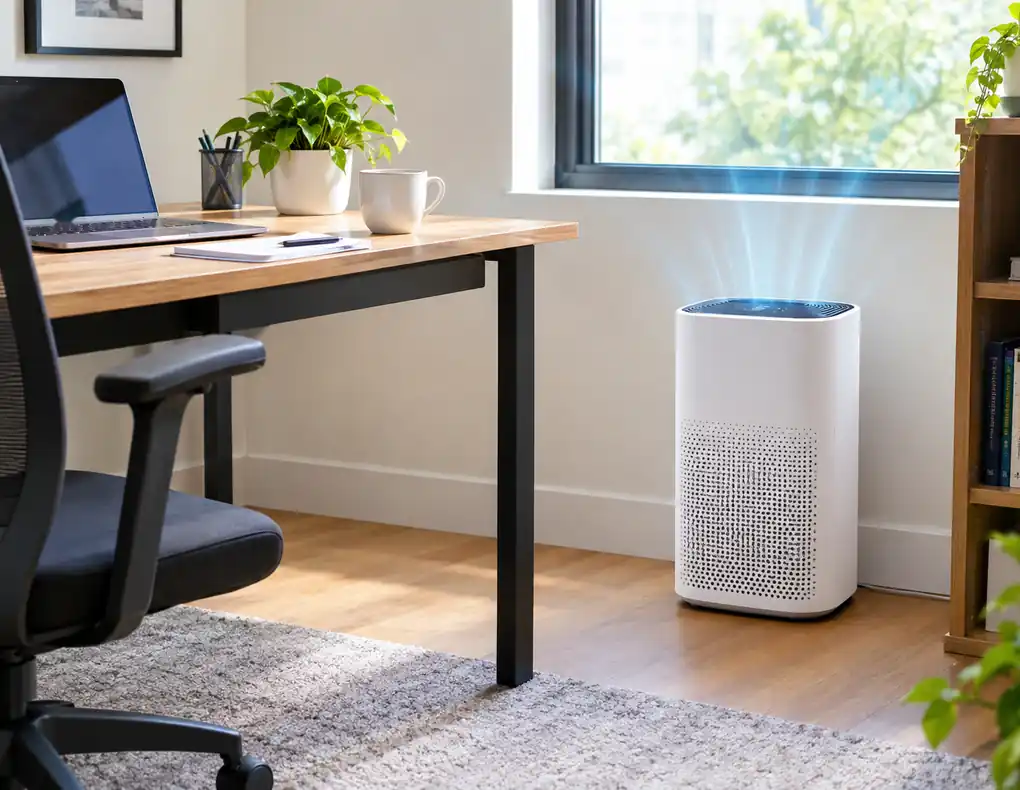
A small home office can feel less comfortable when dust, odors, or stale air become noticeable during the workday.
The difficult part is finding an air purifier that fits the room without becoming another bulky appliance. A unit can have a small footprint and still be poorly matched to the room if its clean air delivery rate is too low. Another model may have enough capacity but become distracting because of fan noise or awkward placement.
The best compact air purifiers for small home offices should therefore be judged by more than their physical size.
Room coverage, tobacco smoke CADR, filtration, noise, dimensions, filter replacement, and placement all matter. This guide explains those details and compares five compact options worth considering.
Affiliate Disclosure: Some links on Buy Facto may be affiliate links. If you purchase through one of these links, we may earn a commission at no extra cost to you.
Amazon Associates Disclosure: As an Amazon Associate I earn from qualifying purchases.
The product categories in this guide are not based on our own laboratory testing. They are intended to help you understand the specifications worth comparing when shopping.
Best Compact Air Purifiers for Small Home Offices
| Option | Useful for | Main thing to watch |
|---|---|---|
| Multi-stage filtration | General small-office use | Replacement-filter cost |
| Washable pre-filter | Rooms with visible dust or hair | Main filter still needs replacement |
| Slim design | Narrow floor areas | Air-intake and outlet clearance |
| Air-quality sensor | Automatic fan control | Sensor readings are approximate |
| Portable design | Moving between suitable rooms | Limited CADR on very small units |
These options are different approaches to the same basic problem: adding air filtration without making a compact room harder to use.
Start With Room Size and Smoke CADR
Before comparing features, work out the size of the room.
For example, a 10 × 10 ft office has 100 square feet of floor area. With an 8 ft ceiling, that is roughly 800 cubic feet of air.
The U.S. Environmental Protection Agency provides a sizing table that lists a minimum CADR of about 65 cfm for a 100-square-foot room with an 8-foot ceiling. EPA’s guidance also recommends looking at the tobacco smoke CADR when choosing a cleaner for smaller airborne particles.
You can read the full guidance in the EPA’s Guide to Air Cleaners in the Home.
AHAM also uses a roughly two-thirds-of-room-area approach for smoke CADR, which gives approximately 67 cfm for a 100-square-foot room.
The exact number does not need to become a complicated calculation every time you shop.
The important point is to compare the purifier’s published smoke CADR with the room it is intended to serve.
If the ceiling is higher than 8 feet, EPA recommends considering a cleaner with higher CADR because the room contains more air.
CADR Is Not the Same as Raw Airflow
Some product listings give airflow numbers in m³/h instead of CADR.
Those numbers are not automatically interchangeable.
CADR describes the delivery of cleaned air, while a general airflow figure may simply describe how much air the fan moves under particular conditions.
When comparing portable air cleaners for room filtration, a published CADR is much more useful than a raw airflow number.
1. Compact Purifier With Multi-Stage Filtration
[Check Price — Compact Air Purifier With Multi-Stage Filtration]
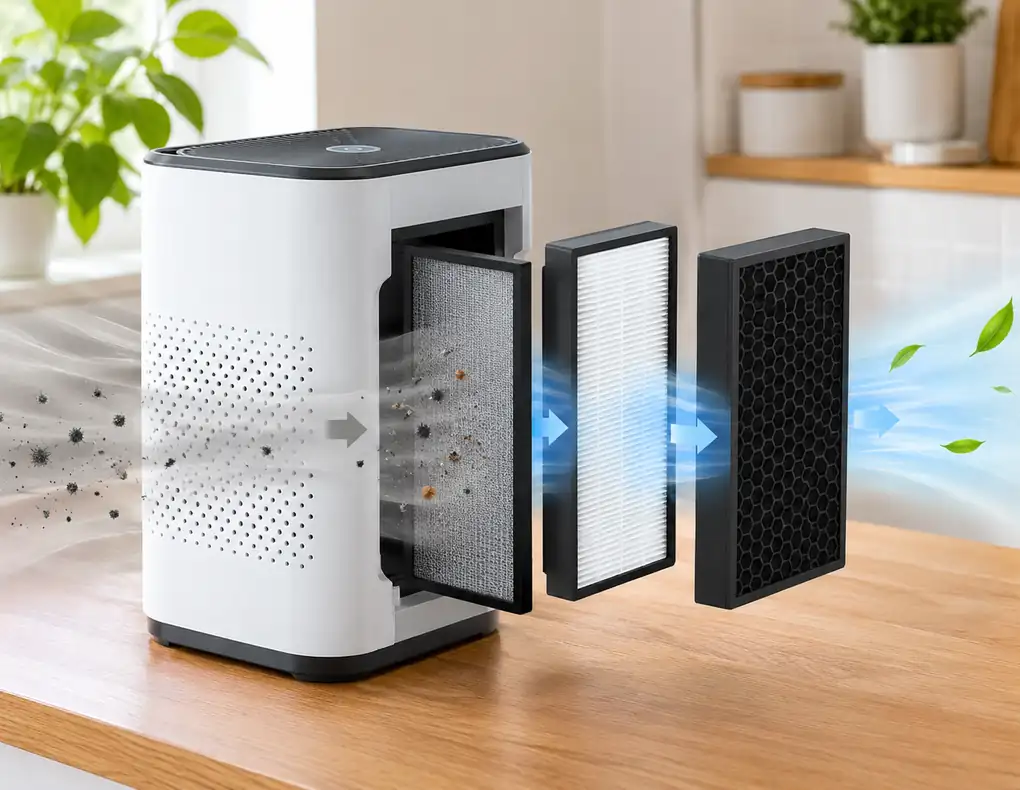
A compact purifier with multiple filtration stages can be a sensible choice when you want one appliance to handle different parts of the filtration process.
A typical design might include a pre-filter for larger particles, a finer particle filter, and activated carbon for gases or odors.
The exact arrangement varies considerably between products, so the specification sheet matters more than the number of stages printed on the packaging.
What to Compare
Look for:
- Published tobacco smoke CADR
- Clearly specified particle filtration
- HEPA filtration when required by your buying criteria
- Activated carbon when odor or gas filtration matters
- Replacement-filter availability
- Filter replacement instructions
- Physical dimensions
EPA describes HEPA as a type of pleated mechanical filter that can theoretically remove at least 99.97% of 0.3-micron particles under the stated test conditions.
Activated carbon serves a different purpose. EPA notes that carbon can be useful for gases, but performance depends partly on having a sufficient amount of carbon material in the filter.
Watch the Long-Term Cost
A purifier with several filtration stages may require more than one type of replacement component.
Before purchasing, check the price and availability of the complete replacement filter setup.
A low initial price is less useful if the filters become difficult or expensive to replace.
2. Compact Purifier With a Washable Pre-Filter
[Check Price — Compact Air Purifier With Washable Pre-Filter]
A washable pre-filter can be useful in rooms where larger particles accumulate quickly.
Hair, lint, and visible dust can collect on an outer pre-filter before the air reaches the finer filtration stage.
A washable component may make routine cleaning more convenient, but it does not mean the purifier is maintenance-free.
What to Check
Find out:
- Whether the pre-filter is actually washable
- How it should be cleaned
- Whether it must dry completely before use
- Which other filters need replacement
- How the filter compartment is accessed
Do not assume that every removable mesh or outer screen can be rinsed.
Follow the instructions for the specific purifier.
Why This Can Make Sense
A small office that shares space with a bedroom or another active part of the home may collect visible dust more quickly than a rarely used room.
A purifier with an easy-to-maintain pre-filter can therefore be convenient for regular use.
The main filter still needs to be maintained or replaced according to the manufacturer’s instructions.
3. Slim Compact Air Purifier
[Check Price — Slim Compact Air Purifier]
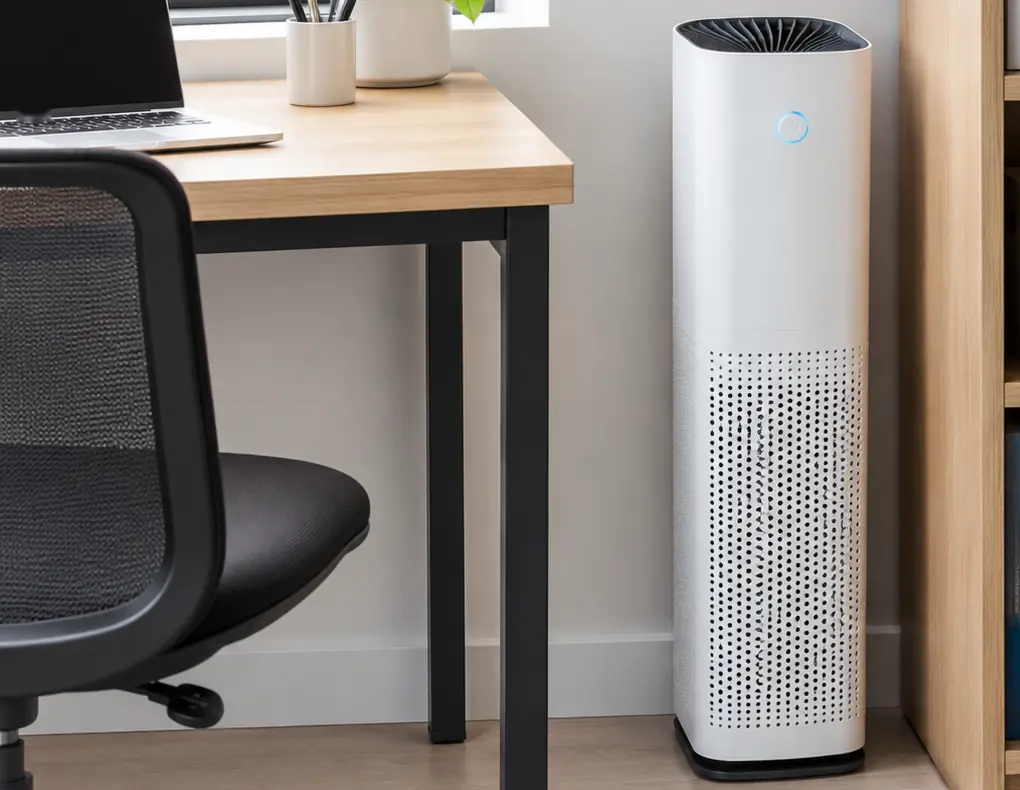
A slim purifier is designed around a simple space problem: there may be enough vertical room, but very little floor width.
That makes this style useful for offices where the remaining open area is beside furniture, shelving, or another fixed object.
The mistake is assuming that a narrow footprint automatically makes a product suitable.
Check All Three Dimensions
Before ordering, measure:
- Height
- Width
- Depth
Then look at the location of the air intake and air outlet.
A slim purifier may fit into a narrow gap but still be unsuitable if the intake is located against a wall or furniture.
You should also check how much room is needed to access the filter.
A product that fits perfectly today can become inconvenient if you cannot open its filter compartment later.
Keep the Cable Out of the Way
The purifier should also have a sensible power connection.
Avoid routing the cable across a walking path.
Our guide to Best Cable Management Solutions for Small Desks covers practical ways to keep workspace cables more organized.
The purifier does not need to sit on the desk. In a small office, a suitable floor or side location may preserve more working surface, provided the manufacturer’s placement requirements are followed.
4. Compact Purifier With an Air-Quality Sensor
[Check Price — Compact Air Purifier With Air-Quality Sensor]
Some compact purifiers include sensors that can change the fan setting automatically when the sensor detects a change in the conditions it measures.
This can be convenient when you do not want to keep adjusting the controls throughout the day.
However, a sensor display should be treated as an indicator rather than a laboratory measurement.
What Does the Sensor Actually Measure?
Before buying, check the specifications.
The product may identify the type of sensor or the type of particles or conditions it is designed to detect.
Also look for:
- Automatic mode
- Manual fan control
- Display brightness control
- Display-off option
- Sensor information in the specification sheet
A clear manual mode is useful because you may prefer a fixed low speed during focused work.
Automatic mode can change the fan speed when the purifier detects a change. Having direct control gives you another option when you want predictable operation.
5. Portable Compact Air Purifier
[Check Price — Portable Compact Air Purifier]
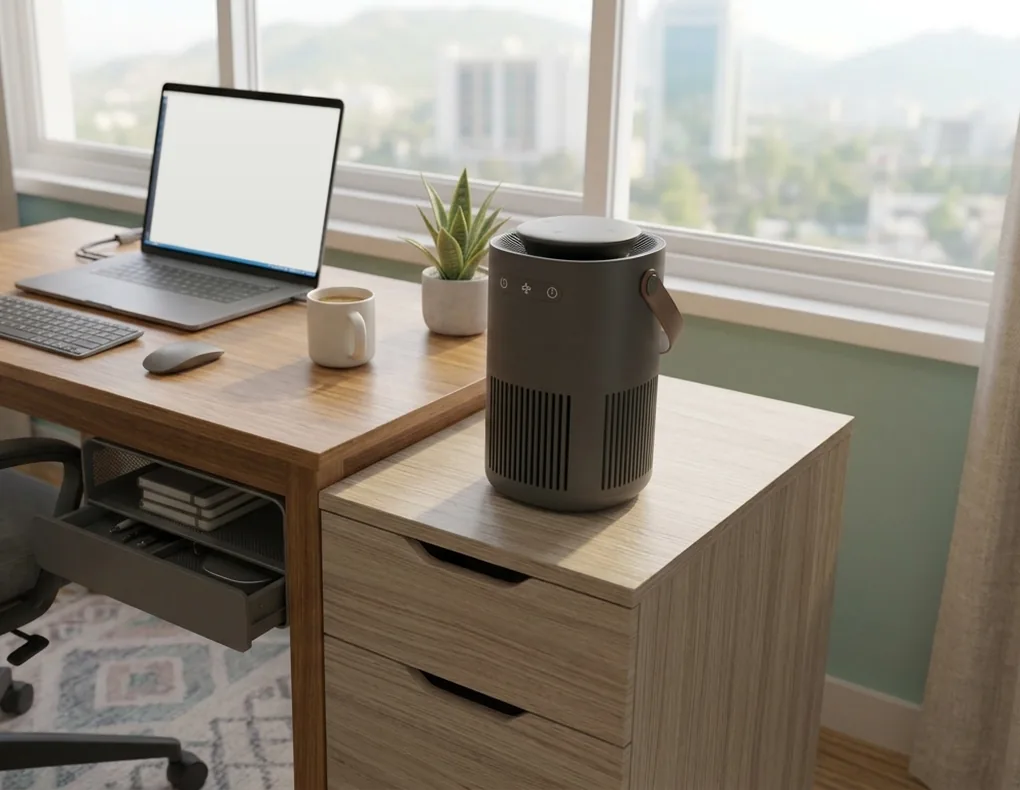
Portability becomes useful when the same purifier will be used in more than one suitable room.
You might use it in the home office during working hours and move it elsewhere later rather than keeping separate appliances in different rooms.
But “portable” covers a wide range of products.
Some are compact enough to carry easily but may have limited airflow and room coverage.
Do Not Judge Portability by Size Alone
Compare:
- Published tobacco smoke CADR
- Intended room size
- Weight
- Stability
- Power requirements
- Filter availability
- Filter replacement cost
A very small USB-powered appliance should not automatically be treated as a whole-room purifier.
Look for actual CADR or clear manufacturer room-sizing information before expecting it to serve the entire office.
The Important Detail About CADR and Fan Speed
One of the easiest specifications to misunderstand is CADR.
The CADR shown in a product listing is typically measured at the air cleaner’s highest fan speed. EPA states that lower fan speeds filter less air, and King County similarly warns that the full listed CADR may not be achieved when the unit operates at a lower or automatic setting.
This matters in a home office.
You may buy a purifier with enough published CADR for your room but normally run it on a lower setting because you prefer less fan noise.
That means you should not evaluate the purifier solely by its maximum CADR.
Think about the speed you are realistically comfortable using.
For a quiet workspace, a purifier with more capacity can give you more flexibility to operate at a lower setting, although the actual result depends on the specific product.
How Much Noise Should You Expect?
Noise is highly relevant when the purifier will run while you are working.
A product may advertise a low noise number based on its quietest setting. The sound at medium or maximum speed can be considerably different.
When comparing products, look for noise information at multiple settings when it is available.
King County recommends looking for HEPA air cleaners with a noise rating of 50 dB or less and notes that a larger-capacity cleaner can sometimes be operated at a lower speed to reduce noise.
There is no single number that guarantees a purifier will feel quiet in every office.
Distance also matters. A purifier placed very close to your chair may be more noticeable than the same unit placed farther away.
The useful question is:
Can the purifier provide the cleaning performance you need at a fan speed you can comfortably tolerate?
Where Should You Put It?
The best location is one that allows the purifier to operate without blocked airflow or creating a practical problem around the room.
Follow the manufacturer’s clearance instructions rather than using one universal distance.
Before choosing a location, check:
- Air-intake position
- Air-outlet position
- Nearby furniture
- Curtains
- Walking paths
- Door movement
- Power-cable routing
- Filter-access space
Do not squeeze the purifier into a corner simply because the space appears unused.
A small office benefits from deliberate placement. You want the appliance to fit into the room without interfering with furniture or the normal movement around your workspace.
Our Small Home Office Layout Ideas guide covers broader ways to make limited floor space work.
Should an Air Purifier Go on the Desk?
Not automatically.
A compact purifier may physically fit on the desk, but that does not mean the desk is the best location.
Every appliance placed on the desk uses space that could otherwise remain available for work.
Before using a desk as the purifier’s location, check the manufacturer’s placement instructions and consider whether the remaining work surface is still comfortable.
A suitable floor or side location may protect more of the desk area.
The important thing is not whether the purifier looks small.
It is whether the whole setup remains practical.
What to Look for in the Filtration System
Different filtration stages solve different problems, so do not judge the filter by one label alone.
Particle Filtration
For airborne particles, look for a clearly specified particle filter and a useful smoke CADR.
EPA notes that tobacco smoke CADR is used to represent the removal of smaller particles when comparing portable air cleaners.
HEPA Filtration
HEPA is a defined type of mechanical filter.
EPA says HEPA filters can theoretically remove at least 99.97% of 0.3-micron particles under the stated conditions.
Avoid treating vague terms such as “HEPA-like” as equivalent to a clearly specified HEPA filter.
Activated Carbon
Carbon is relevant when gases and odors are part of your buying criteria.
EPA notes that gas filtration does not have the same widely used performance rating system as particle CADR, and that the amount of carbon material can affect performance.
That makes the actual filter construction worth checking.
Do Not Forget Filter Replacement
The purifier is not a one-time purchase.
Filters collect material over time and eventually need maintenance or replacement. EPA notes that overloaded filters do not work well and that filters require regular replacement.
Before buying, check:
- Replacement-filter price
- Replacement interval
- Filter availability
- Cleaning requirements
- Ease of access
For example, an illustrative filter set costing $25 and lasting six months would work out to about $50 per year.
That is an example rather than a product price.
The actual cost will depend on the purifier and the manufacturer’s replacement schedule.
Air Purifier vs Ventilation
An air purifier filters indoor air.
It does not replace ventilation and does not remove carbon dioxide.
EPA explains that filtration should supplement source control and ventilation rather than replace them.
So if a room feels stuffy because there is not enough fresh air, an air purifier is not the complete answer.
When outdoor conditions are suitable, ventilation can still be useful.
The two approaches serve different purposes.
Be Careful With Ozone-Generating Features
Some air-cleaning technologies use ionization, electrostatic processes, plasma, or other methods that can create ozone.
EPA advises consumers to avoid portable air cleaners that intentionally produce ozone because ozone can irritate the lungs.
That is why it is worth checking what additional air-cleaning technology a product uses.
A straightforward mechanical filtration system can be easier to evaluate when you want a simple home-office setup.
When a product includes an electronic feature, look for credible information about ozone emissions and any applicable third-party verification.
Red Flags When Comparing Listings
Be more cautious when a product listing:
- Gives no published CADR
- Does not identify the type of particle filtration clearly
- Makes very large coverage claims without useful supporting specifications
- Provides no information about replacement filters
- Shows a noise figure without explaining the operating mode
- Gives little information about airflow clearance
- Focuses heavily on extra features while hiding basic specifications
A product page should give you enough information to understand what you are buying.
If the key specifications are missing, it becomes difficult to make a meaningful comparison.
A Simple Buying Method
When comparing several compact air purifiers, start with the room.
Then check the tobacco smoke CADR and compare it with the space you need to serve.
Next, make sure the physical dimensions work in your intended location.
After that, compare the filtration system, noise information, filter cost, and maintenance requirements.
Only then look at extras such as sensors, automatic modes, displays, timers, or app controls.
This order keeps the most important decisions ahead of the marketing features.
FAQs
What CADR do I need for a 100-square-foot home office?
EPA’s sizing table lists approximately 65 cfm minimum CADR for a 100-square-foot room with an 8-foot ceiling. For smaller particles, EPA recommends looking at the tobacco smoke CADR.
Is a higher CADR always better?
A higher CADR means the cleaner can deliver more filtered air, but the usefulness of that additional capacity depends on the room, placement, and fan speed you actually use.
Does the listed CADR apply at every fan speed?
Usually not. EPA says CADR is typically measured at the highest speed, while lower fan speeds filter less air.
Is a HEPA filter important?
It can be useful when particle filtration is an important part of your buying criteria. EPA describes HEPA as a specific type of mechanical filter with a theoretical 99.97% removal efficiency for 0.3-micron particles under the stated conditions.
Can an air purifier remove odors?
Some models use activated carbon for gases and odors. The amount of carbon material matters, so compare the actual filter design rather than assuming every carbon filter performs the same way.
Can an air purifier replace ventilation?
No. A purifier filters indoor air but does not replace ventilation or remove carbon dioxide.
Are tiny USB air purifiers suitable for a whole room?
Do not assume so. Very small units may have limited CADR. Check the actual product specifications and intended room size before expecting whole-room coverage.
How often should air purifier filters be replaced?
Follow the manufacturer’s instructions. Replacement needs vary by product, filter design, usage, and operating conditions.
Can I put an air purifier on my desk?
It depends on the product and its placement requirements. Even when possible, desk placement may reduce useful working space.
Is a quiet air purifier better for a home office?
Low operating noise can be valuable when you work, read, study, or attend meetings. Compare the noise information with the fan speed you are most likely to use rather than relying only on the word “quiet.”
Final Thoughts
Choosing a compact air purifier is less about finding the smallest appliance and more about matching the purifier to the room.
Start with the tobacco smoke CADR and room size. Then check the purifier’s filtration system, dimensions, noise information, placement requirements, and replacement-filter cost.
A multi-stage purifier can provide several filtration steps in one unit. A washable pre-filter can make routine cleaning more convenient. Slim models can solve narrow-space problems, while sensor-equipped and portable designs offer different forms of convenience.
The most useful purifier is the one whose specifications fit your actual room and whose everyday operation fits your routine.
For more ideas about creating a practical small workspace, explore our Small Home Office guides.