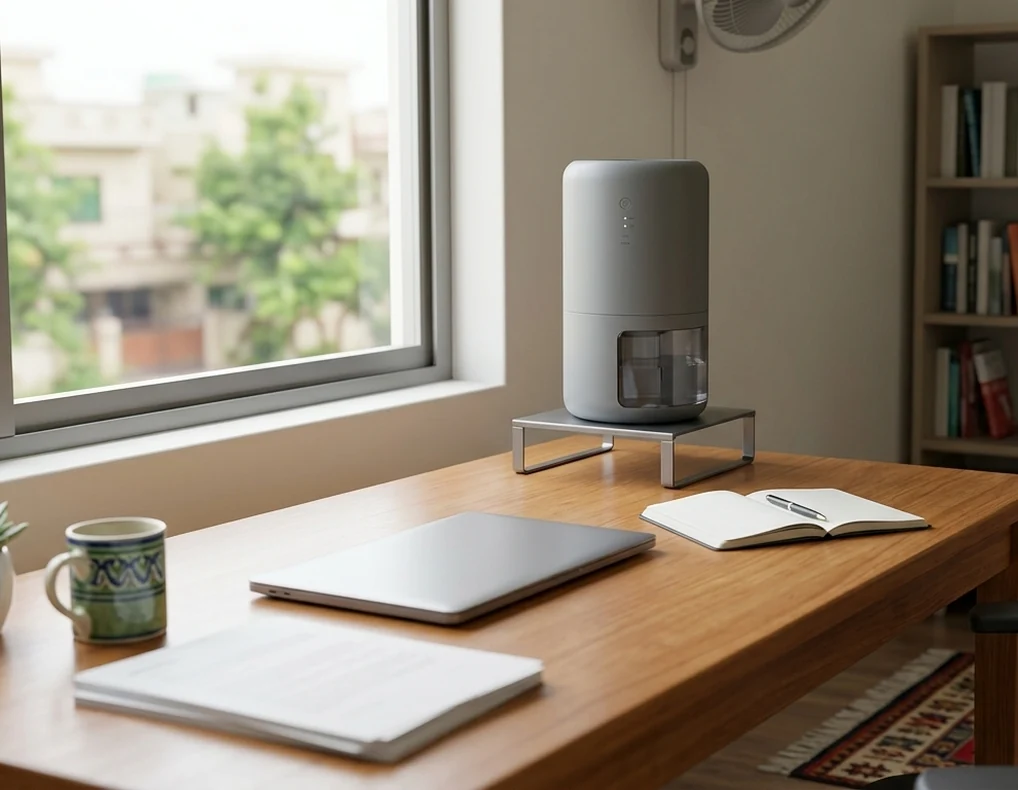
Finding the best compact dehumidifiers for small home offices can be difficult when you need effective moisture control without giving up valuable floor or desk space. The room may feel damp, windows can develop condensation, and musty odors may become more noticeable. In some spaces, excess moisture can also make paperwork, furniture, and electronics feel less comfortable to use.
The challenge is finding a dehumidifier that can help control moisture without taking up too much valuable floor or desk space.
Compact dehumidifiers come in different designs, capacities, and operating styles. Some are designed for light-duty moisture removal, while others are better suited to rooms that regularly experience higher humidity.
In this guide, we compare five compact dehumidifier types that can work well in small home offices and explain the features that are actually worth considering.
Affiliate Disclosure: Some links on Buy Facto may be affiliate links. If you purchase through one of these links, we may earn a commission at no additional cost to you.
Amazon Associates Disclosure: As an Amazon Associate I earn from qualifying purchases.
Note: The product categories and recommendations in this guide are based on features, use cases, and space-saving considerations. They are not based on our own laboratory testing.
5 Best Compact Dehumidifiers for Small Home Offices to Consider
| Compact Dehumidifier Type | Best For | Potential Limitation |
|---|---|---|
| Compact compressor dehumidifier | Regular moisture control | Usually larger than thermoelectric units |
| Small thermoelectric dehumidifier | Light-duty use in very small spaces | Lower moisture-removal capacity |
| Slim portable dehumidifier | Narrow floor areas | Needs suitable airflow clearance |
| Quiet compact dehumidifier | Workspaces where noise matters | May cost more |
| Compact continuous-drain dehumidifier | Longer unattended operation | Requires suitable drainage |
How Dehumidifier Capacity Is Measured
Dehumidifier capacity is commonly described in pints of moisture removed per 24 hours under specified test conditions.
The right capacity depends on more than the size of the room. Humidity level, room conditions, ventilation, and how often the space experiences moisture can all affect performance.
A small office with mild humidity may not need the same capacity as a room that regularly feels damp.
Energy efficiency is another useful consideration. ENERGY STAR uses Integrated Energy Factor (IEF) as an efficiency metric for portable dehumidifiers, allowing shoppers to compare moisture removal with energy consumption under standardized conditions.
Instead of choosing the largest unit available, consider the actual moisture problem first.
1. Compact Compressor Dehumidifier
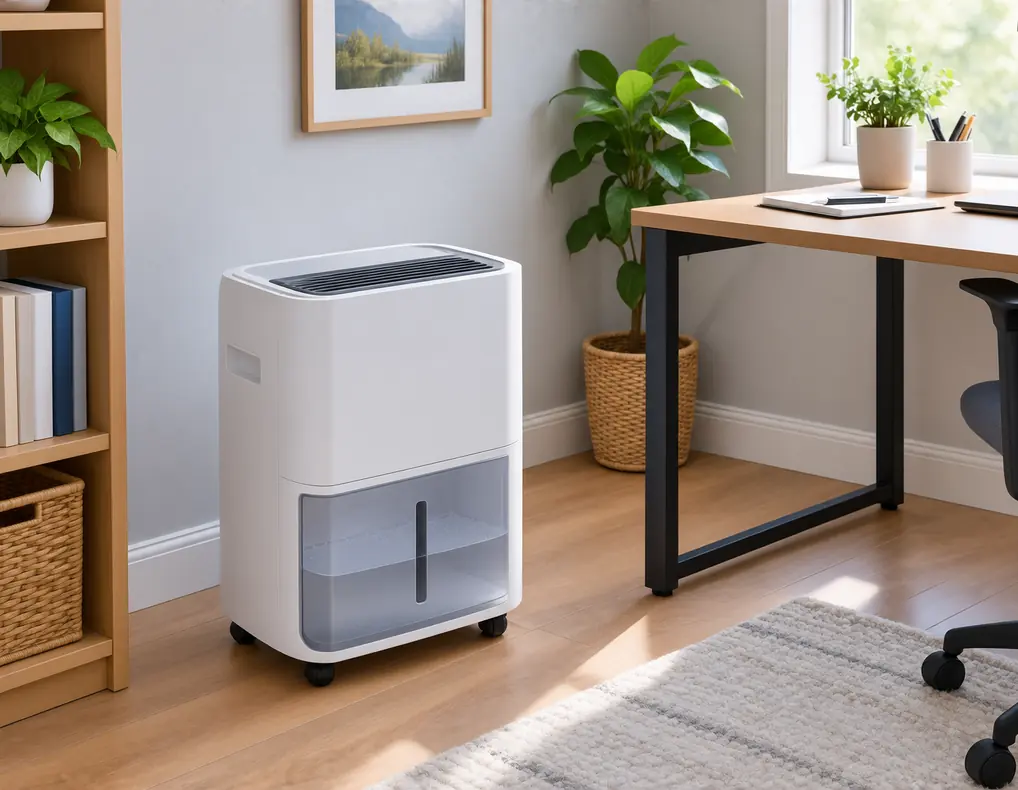
A compact compressor dehumidifier is a practical option when your small office experiences regular or noticeable humidity.
These units use a refrigeration-based process to cool a surface, allowing moisture from the air to condense and collect as water. This design is common in many portable dehumidifiers intended for more consistent moisture control.
Why Consider One?
A compact compressor model can make sense if:
- The room regularly feels humid
- You need more moisture removal than a tiny desktop unit can provide
- The office is larger than a very small enclosed workspace
- You want a unit that can operate for longer periods
The main trade-off is size. Compressor units can be larger and heavier than thermoelectric models.
What to Check
Look at:
- Moisture-removal capacity
- Tank size
- Noise level
- Automatic shutoff
- Humidity controls
- Filter access
- Energy efficiency
If you have enough floor space, this type can provide a more capable solution for recurring humidity.
2. Small Thermoelectric Dehumidifier
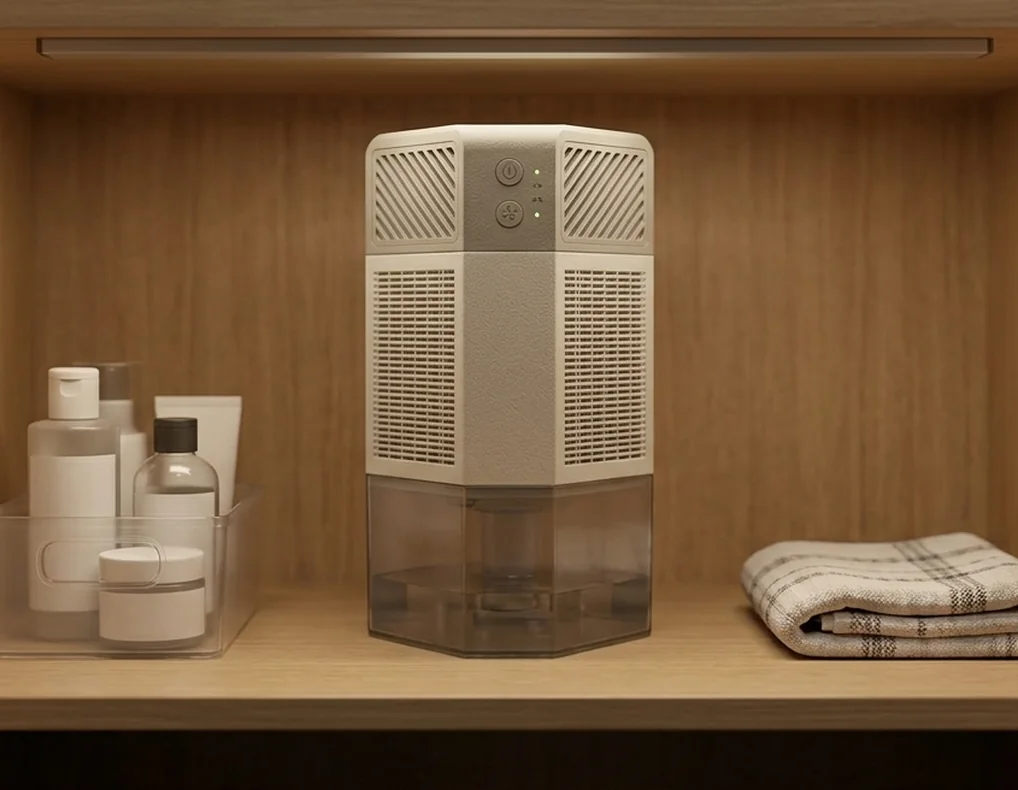
Thermoelectric dehumidifiers are designed for smaller and lighter-duty applications. They use a thermoelectric cooling system rather than a traditional compressor.
Their compact size can make them attractive for very small rooms, closets, personal work areas, or other locations where space is limited.
Why Consider One?
A thermoelectric model may be useful when:
- Moisture levels are relatively mild
- You have very limited space
- Portability is important
- You want a simple setup
They are often easier to place on a small surface or in a compact area.
The Limitation
The main issue is capacity. A small thermoelectric unit may not be suitable for a larger office or a room with serious moisture problems.
Before buying one, consider whether you need actual room-level humidity control or simply light moisture reduction.
3. Slim Portable Dehumidifier
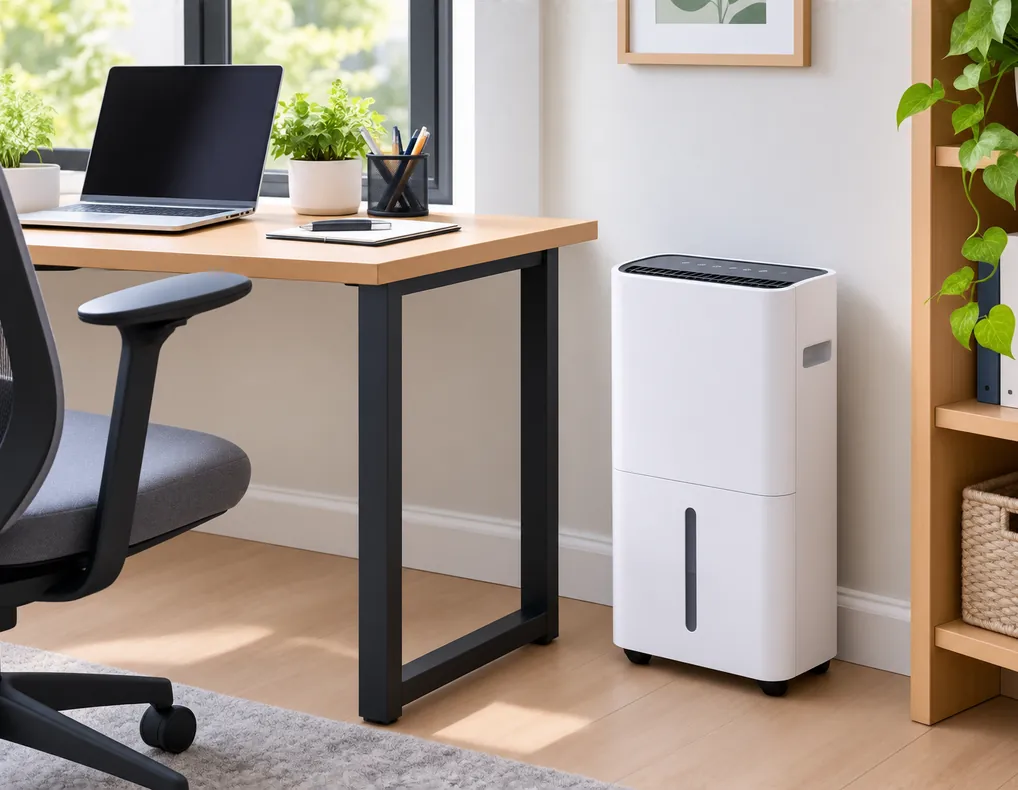
A slim portable dehumidifier focuses on reducing the amount of floor space required.
The narrower design can be useful when your home office has limited space around the desk, chair, shelves, or other furniture.
Why Consider One?
A slim design can work well when:
- Floor width is limited
- You have a narrow corner available
- The office doubles as another living space
- You want to keep the main walking area clear
However, slim does not automatically mean better.
A dehumidifier still needs adequate airflow around its intake and exhaust areas. Placing it directly against a wall, behind furniture, or inside a tightly enclosed space can reduce effective operation.
A Useful Detail
Compact categories are not always mutually exclusive.
For example, a slim portable model can also use a compressor, while a quiet compact model may use either a compressor or thermoelectric design.
That means you should compare the actual specifications instead of assuming that every category represents a completely different technology.
4. Quiet Compact Dehumidifier
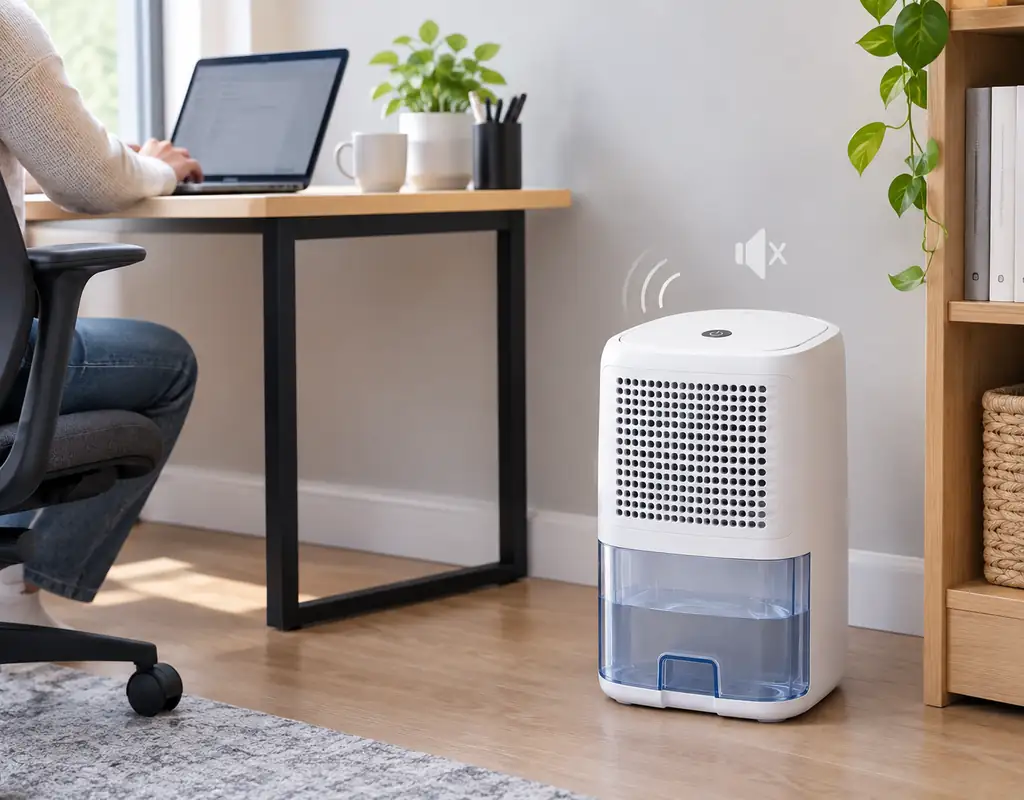
Noise matters more in a home office than it does in many other rooms.
A dehumidifier may run while you are working, attending online meetings, reading, or concentrating. A noisy fan or compressor can become distracting over time.
A quiet compact dehumidifier is therefore worth considering if the office is also used for focused work.
What to Look For
Check whether the manufacturer provides:
- Noise information
- Multiple fan speeds
- Sleep or quiet modes
- Automatic humidity control
- Timer functions
Remember that “quiet” is a relative term. Two models may both be marketed as quiet while producing noticeably different operating sounds.
If possible, check user reviews for comments about real-world noise during normal operation.
Where Should It Go?
Avoid placing the unit directly beside your chair if the sound is distracting.
A position a little farther away, with sufficient airflow around the unit, may provide a better balance between moisture control and working comfort.
5. Compact Continuous-Drain Dehumidifier
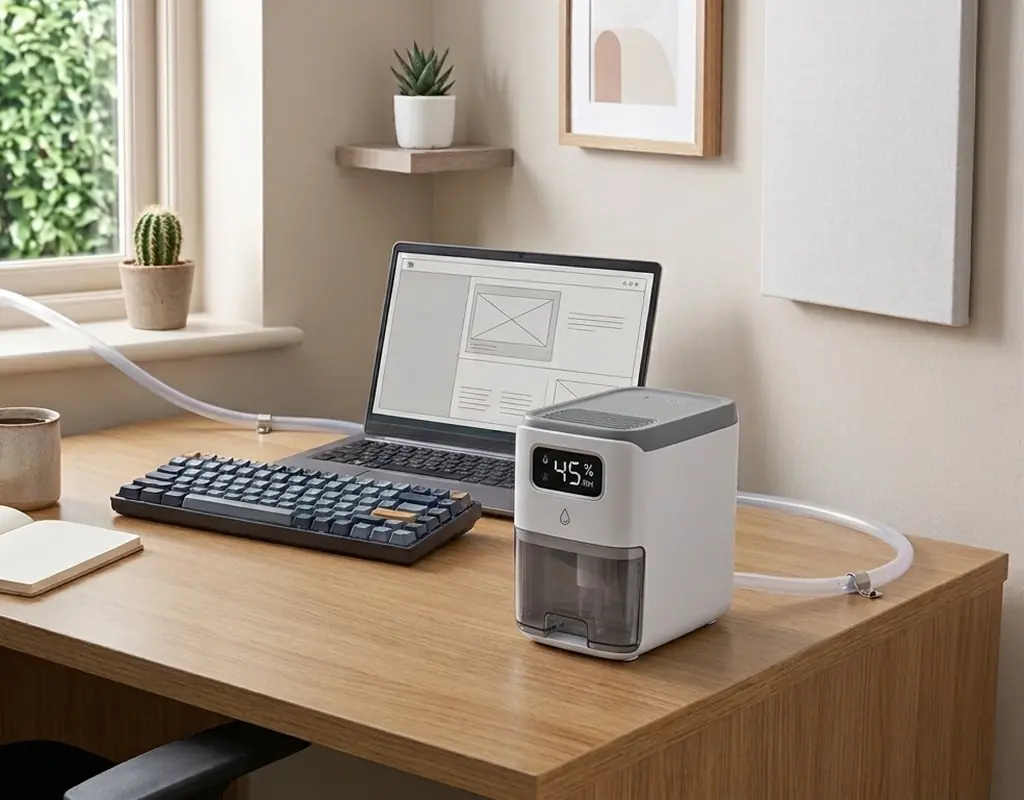
A compact continuous-drain dehumidifier can be useful when you do not want to empty the water tank repeatedly.
Instead of relying only on the built-in collection bucket, compatible models can use a hose to direct collected water toward a suitable drain.
Why Consider One?
This feature can be helpful when:
- Humidity is consistently high
- You want longer unattended operation
- Emptying the tank frequently is inconvenient
- The unit is located near a suitable drainage point
What to Check
Before buying, confirm:
- Whether continuous drainage is supported
- What type of hose connection is required
- Whether the hose is included
- Whether the drainage setup needs gravity or a pump
- Where the water can safely drain
Continuous drainage is convenient, but it only makes sense when you have a practical and safe place for the collected water to go.
Where Should a Dehumidifier Go?
Placement can affect how well a compact dehumidifier works.
Try to keep the unit in an area where air can circulate freely. Avoid pushing it tightly against a wall or placing it behind a desk, cabinet, or other object that blocks airflow.
For a small home office, a practical location may be:
- Near an area where humidity is noticeable
- Away from direct obstruction
- On a stable, level surface
- Where the power cord can be positioned safely
- Away from areas where spilled water could damage electronics
If your office is also used as a bedroom or living area, consider how the unit’s noise and airflow will affect the rest of the room.
How Much Capacity Do You Actually Need?
Capacity should be based on the actual moisture problem rather than simply choosing the largest model.
Consider:
- Room size — A larger room generally requires more capacity.
- Humidity level — A consistently damp room may need more moisture-removal capability.
- Ventilation — Poor airflow can affect how the room feels and how moisture behaves.
- Moisture sources — Cooking, drying clothes, leaks, and other sources can increase humidity.
- How often you will run the unit — Occasional use is different from daily operation.
A tiny desktop unit may be enough for light-duty moisture control, but it should not be expected to solve a serious moisture problem in a larger room.
What Does a Full Water Tank Mean for You?
Most portable dehumidifiers collect extracted moisture in a removable tank.
Many models include an automatic shutoff feature that stops operation when the collection bucket becomes full. This can help prevent overflow.
ENERGY STAR notes that portable dehumidifiers commonly use removable collection buckets and automatic shutoff features.
For a home office, tank size can matter almost as much as moisture-removal capacity.
A small tank may fill quickly in a humid room, requiring frequent emptying. A larger tank can reduce how often you need to interrupt your work.
Energy Use and Efficiency
A dehumidifier uses electricity while operating, so efficiency becomes more important when you plan to run it regularly.
Rather than judging efficiency from wattage alone, look for standardized efficiency information where available.
ENERGY STAR uses Integrated Energy Factor (IEF) for portable dehumidifiers. This provides a standardized way to compare moisture removal and energy consumption.
You should also consider how often the unit will actually run.
A smaller, appropriately sized unit that operates only when necessary may be more practical than choosing a much larger model and running it unnecessarily.
Do You Need a Humidity Control?
A built-in humidity control can be useful because it allows the dehumidifier to respond to changing room conditions.
Instead of simply running continuously, some models can monitor humidity and adjust operation according to a selected setting.
This can be useful for a home office because you may not need maximum moisture removal throughout the entire day.
A humidity control can also make the unit easier to manage when the office is left unattended for a period of time.
Compact Dehumidifier vs Air Purifier
A dehumidifier and an air purifier solve different problems.
A dehumidifier removes moisture from the air, while an air purifier is designed to filter airborne particles.
If your main concern is humidity, condensation, or a damp feeling, a dehumidifier is the more directly relevant appliance.
If your concern is airborne particles, dust, or other filtration needs, an air purifier may be more appropriate.
For a small home office, it is important to identify the actual problem before buying another appliance.
You can also see our guide to Best Compact Air Purifiers for Small Home Offices if air filtration is your main concern.
When a Dehumidifier May Not Solve the Real Problem
A dehumidifier can remove moisture from the air, but it may not fix the source of excessive moisture.
For example, if your office has:
- A plumbing leak
- Water entering through a wall or window
- Roof leakage
- Persistent condensation caused by a building problem
- Poor ventilation
- Moisture coming from another part of the property
then simply running a dehumidifier may only treat the symptom.
If moisture keeps returning quickly, investigate the source instead of relying entirely on an appliance.
This is especially important when you notice visible water damage, mold growth, peeling paint, or persistent musty odors.
Maintenance You Should Expect
Compact dehumidifiers still need regular maintenance.
Depending on the model, you may need to:
- Empty and clean the water tank
- Clean the air filter
- Check the air intake
- Keep the surrounding area clear
- Inspect the drainage hose if continuous drainage is used
Always follow the manufacturer’s cleaning and maintenance instructions.
A neglected filter or blocked airflow can reduce performance and make the appliance work harder.
For a small office, simple maintenance is usually easier when the unit is placed somewhere that is easy to reach.
Common Buying Mistakes
Choosing Based Only on Size
The smallest dehumidifier is not automatically the best choice. If the unit is too weak for your moisture problem, you may end up running it constantly without getting the result you want.
Ignoring Noise
A unit that seems acceptable in a living room may become annoying when placed beside your workstation.
Blocking Airflow
Compact appliances still need space around their intake and exhaust areas.
Forgetting About the Water Tank
A small tank can mean frequent emptying, especially in humid conditions.
Buying More Capacity Than You Need
An oversized unit may take up more room and consume more energy than necessary.
Ignoring Drainage
If you want continuous operation, make sure you actually have a suitable drainage setup.
A Practical Buying Checklist
Before choosing a compact dehumidifier for your home office, check these points:
- Is the capacity suitable for the room?
- Is the design compact enough for your available space?
- Does it produce a comfortable noise level?
- Is the water tank large enough for your expected use?
- Does it have automatic shutoff?
- Is humidity control available?
- Can the filter be accessed easily?
- Does it support continuous drainage if needed?
- Is the unit energy efficient?
- Can you place it somewhere with good airflow?
- Will maintenance be simple?
- Does the price make sense for how often you will use it?
A short checklist like this can help you avoid buying a model based only on appearance or advertised compact size.
FAQs
Are compact dehumidifiers good for small home offices?
Yes, they can be useful when humidity is higher than comfortable. The right model depends on room size, humidity level, moisture sources, and how often you plan to use it.
Can I put a dehumidifier on my desk?
Some very small thermoelectric models are designed for desktop or compact placement. Larger units are generally better placed on the floor or another stable surface with sufficient airflow.
Is a thermoelectric dehumidifier better than a compressor model?
Neither is automatically better for every situation. Thermoelectric models can be useful for light-duty moisture removal and very small spaces, while compressor models are generally better suited to more consistent moisture-control needs.
How often should I empty a dehumidifier?
It depends on humidity, tank size, and how much moisture the unit removes. A humid room can fill the collection tank much faster than a relatively dry room.
Does a dehumidifier remove dust?
A dehumidifier is primarily designed to remove moisture. While its air filter may catch some particles, it should not be treated as a replacement for a dedicated air purifier.
Should I run a dehumidifier all day?
That depends on the room conditions and the appliance’s controls. Models with automatic humidity control can be more convenient because they can adjust operation according to the selected humidity setting.
Can a dehumidifier fix mold?
A dehumidifier can help reduce excess moisture, which may help create less favorable conditions for mold growth. However, it does not remove the underlying source of a leak or eliminate existing mold. Persistent moisture problems should be investigated separately.
Final Thoughts
The best compact dehumidifier for a small home office depends on the actual moisture problem and the amount of space available.
A compact compressor dehumidifier can be a practical choice for regular moisture control, while a thermoelectric model may suit light-duty use in very small spaces. A slim portable design can help when floor width is limited, and a quiet model may be more comfortable for people who work near the appliance. If you want longer unattended operation, a continuous-drain model can be worth considering.
Before buying, focus on capacity, noise, tank size, airflow, efficiency, maintenance, and placement rather than choosing a product simply because it is advertised as compact.
If you are also trying to make better use of limited workspace, our Small Home Office Layout Ideas guide can help you plan the available floor area, while our Small Home Office Desk Organization Ideas guide covers practical ways to keep the workspace organized.
For more related ideas, visit the Small Home Office category.