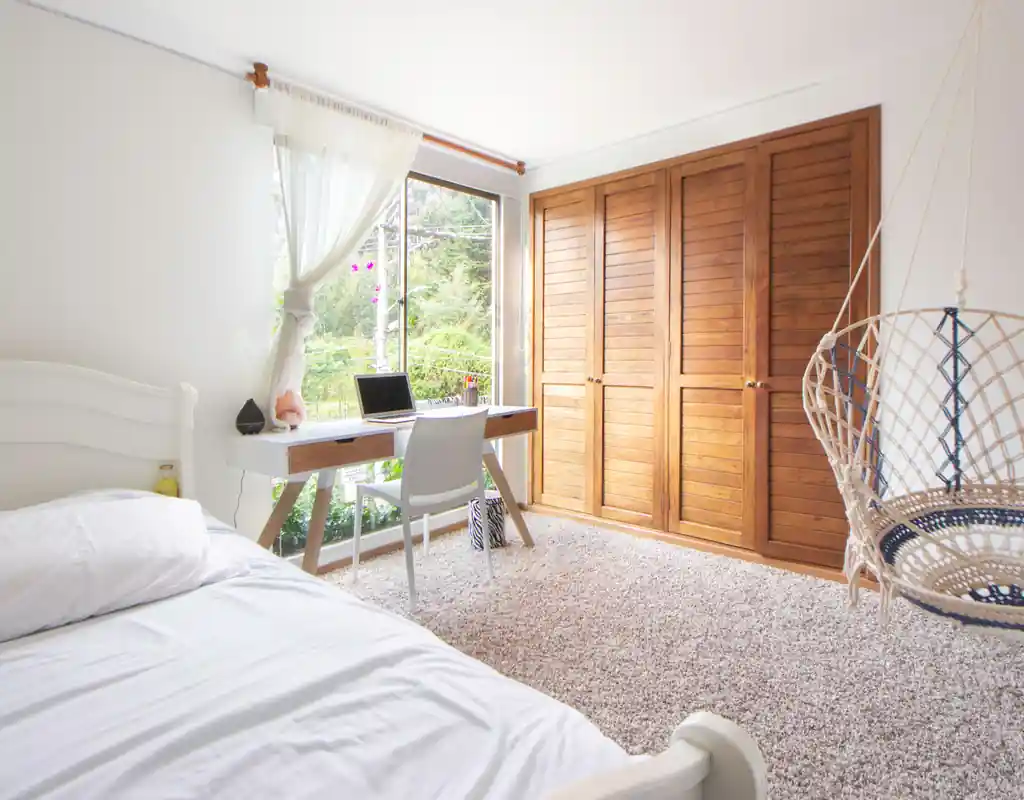
At some point, most small apartments end up with at least one room doing double duty — a bedroom that becomes an office by day, a living room that turns into a guest room when someone stays over, or a dining nook that’s really just a desk with extra chairs. It’s not a design choice so much as a practical reality when square footage is limited.
The tricky part isn’t fitting two functions into one room — it’s making the room actually feel like it can switch between them, instead of permanently looking like a compromise. That comes down more to organization and zoning than it does to buying the right furniture. If furniture is the piece you’re still missing, our guide to multi-functional furniture for small apartments covers that side of things — this one’s about arranging what you’ve already got.
Start by Defining Zones, Even in a Small Room
The biggest mistake in a multi-purpose room is letting everything blend into one undefined space. Even in a room that’s only 10 by 12 feet, you can usually carve out a sense of separation between functions — a desk angled toward the wall instead of the bed, a rug that marks off a “living” area from a “sleeping” one, or a bookshelf used as a low divider instead of pushed flush against a wall.
You don’t need architectural changes to do this. A rug, a curtain, or even just consistent furniture placement can signal “this corner is for work” versus “this corner is for rest” — and that mental separation matters more than people expect. Rooms that mix everything together tend to feel cluttered even when they’re objectively tidy, simply because nothing has a defined place.
Let Lighting Do Some of the Work
Lighting is an easy way to shift a room’s mood between functions without moving a single piece of furniture. A bright overhead light or desk lamp signals “focus mode” for work, while a warmer floor lamp or bedside light shifts the same corner into something calmer once the workday’s done.
If your desk sits inside your bedroom, this matters more than it sounds like it should — working under the same dim lamp you use to wind down at night makes it harder to mentally clock out, and sleeping under bright, work-focused lighting doesn’t help you switch off either. Two distinct lighting setups, even simple ones, go a long way toward making one room feel like it has two identities.
Build in a Reset Routine
A room that switches between uses needs a quick way to switch back — otherwise whichever function you used most recently just takes over permanently. This doesn’t need to be complicated: closing a laptop and sliding a chair in, folding a blanket and setting it in a basket, or tucking a stack of papers into a drawer takes seconds but resets the room’s “mode” instantly.
Without some version of this habit, a multi-purpose room tends to drift toward whichever use is easiest to leave visible — usually work clutter, since packing away a laptop and papers takes more effort than just leaving them out. If organization is a bigger issue than just tidying, our guide to small home office storage ideas has more on keeping desk-related clutter contained in the first place.
Keep Each Function’s Items Grouped Separately
Mixing bins is one of the fastest ways a shared room starts to feel chaotic — a drawer with work supplies, hobby materials, and bedding all shoved in together makes every task take longer, because you’re digging through the wrong category to find what you actually need.
Even simple separation helps: one basket or shelf for work-related items, a different one for whatever the room’s second function requires. It doesn’t need to be elaborate — the goal is just being able to grab what you need for either function without wading through the other one’s mess to find it.
Choose a Visual Style That Works for Both Functions
A room that’s decorated entirely around one function — heavy “office” styling in a room that’s also a bedroom, for instance — tends to feel a little off no matter how organized it is underneath. Neutral, simple decor generally bridges two functions better than something built entirely around just one of them.
This doesn’t mean the room needs to look generic. It just means avoiding decor choices that scream one specific use — a giant motivational work poster right next to your pillow rarely helps the room feel restful, for example, no matter how tidy everything else is.
What to Do If the Room Still Feels Cramped
Sometimes good organization alone doesn’t solve the underlying issue — the room is just genuinely tight for two functions, and something has to give a little.
In that case, prioritize whichever function you use more. If you’re at your desk eight hours a day and only sleep in the room, lean the setup toward “office that happens to have a bed” rather than trying to split it evenly. If it’s the reverse, do the opposite. Trying to give both functions completely equal space in a genuinely small room often means neither one works particularly well — better to commit to a primary use and let the second one adapt around it.
If the desk is the part that’s not working, it might be worth reassessing the piece itself rather than just how it’s organized — our guide to small desks for compact home offices covers a few options built specifically for tight footprints.
Frequently Asked Questions
How do I make a bedroom feel less like an office? Separate lighting for each zone helps a lot, along with keeping desk clutter contained to one spot rather than spread across the room. A visual divider — even just a rug or shelf — reinforces the separation further.
What’s the easiest way to organize a multi-purpose room on a budget? Grouping items by function into separate bins or baskets is close to free and makes an immediate difference. It’s usually a bigger improvement than any single piece of furniture.
Should I decorate a multi-purpose room around one function or split it evenly? It depends on how you actually use the room. If one function dominates your time in the space, it usually makes sense to lean the design toward that one rather than forcing an even split that doesn’t reflect how you live.
Does zoning actually work in a really small room? Yes, though the tools get simpler — a rug, consistent furniture placement, or a shelf used as a low divider can create a sense of separation even in a room too small for a full room divider.
Final Thoughts
A room that serves two purposes doesn’t need to feel like a compromise between them. Most of what makes a shared space work isn’t the furniture — it’s the small organizational habits: defined zones, separate lighting, a quick reset routine, and keeping each function’s belongings in their own place.
Start with whichever part of the room currently feels the most chaotic, fix that one thing, and build from there. A multi-purpose room rarely needs a full redesign — it usually just needs a system.