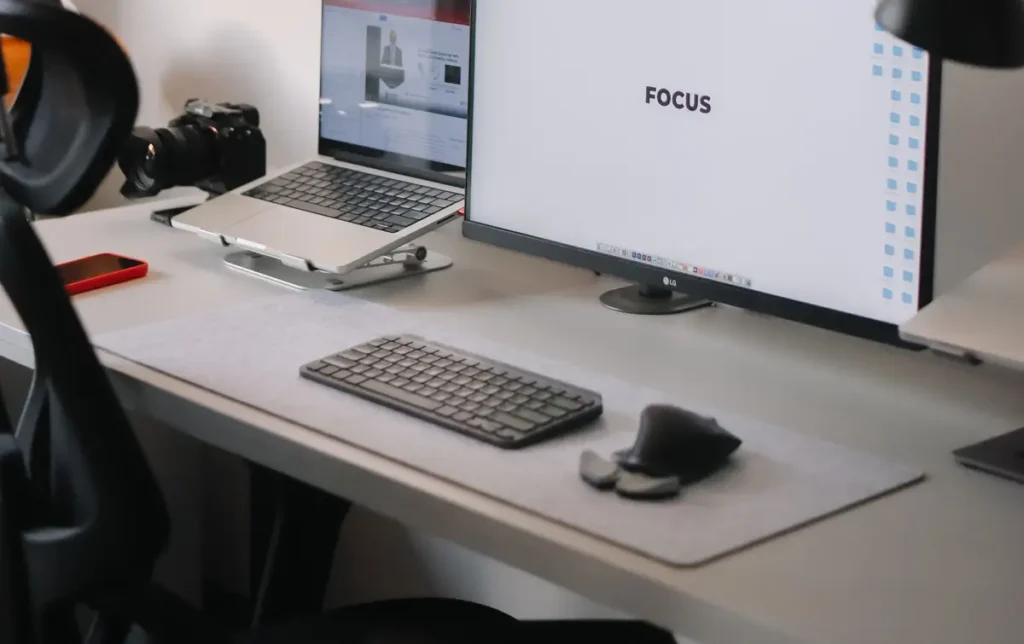
You don’t need to redesign your whole workspace to make it feel better. Sometimes it’s the small accessories — the ones that solve one specific annoyance — that end up making the biggest difference in a compact home office.
If you’re still working out the bigger pieces of your setup, our guide to choosing a small desk is worth a look first. Once the desk itself is sorted, these accessories are what actually make it comfortable to use every day.
Below are ten accessories worth considering, along with what each one actually solves.
1. A Decent Desk Lamp
Lighting gets overlooked more than almost anything else in a home office setup. A compact desk lamp gives you focused light exactly where you need it, without having to light up the whole room just to see your keyboard properly.
For a small desk, look for something with a slim base and an adjustable arm or head — you want light where you need it, not a lamp eating up half your desk surface.
2. A Monitor Stand
A monitor stand does two jobs at once — it lifts your screen to a more comfortable eye level, and it opens up a chunk of storage space underneath for a keyboard, notebook, or small tray.
On a small desk, that underneath space matters more than you’d think. If you run a laptop alongside an external monitor, a stand can also help the whole setup feel more intentional instead of just “stuff on a table.”
3. A Desk Organizer
Pens, sticky notes, cables, scissors, random chargers — small stuff multiplies fast on a desk. A simple organizer gives each of those things an actual spot instead of letting them drift across your workspace.
For small desks specifically, go vertical instead of a wide flat tray. You want the organization without losing surface area.
4. A Laptop Stand
If your laptop is your main machine, a stand changes the ergonomics more than people expect. It raises the screen closer to eye level and frees up the space underneath for a keyboard or a notebook.
Adjustable stands are worth the small extra cost since you can tweak the height and angle instead of settling for whatever the fixed design gives you. A foldable one is even better for small desks — fold it away when you need the extra room.
5. Cable Management Accessories
Cables are probably the fastest way a small desk turns into a mess. Clips, sleeves, ties, and under-desk cable holders keep everything bundled and out of the way instead of hanging loose or tangled behind your monitor.
It’s not just about looks, either — organized cables are a lot easier to trace and unplug when you actually need to swap something out.
6. A Headphone Stand
If you wear headphones while working, you already know where they usually end up — draped over the keyboard, on top of a notebook, wherever there’s room. A small headphone stand gives them one permanent spot instead.
Some stands mount under the desk or attach to the side, which is a nice option if your desktop space is especially tight.
7. A Small Desk Tray
USB drives, adapters, keys, spare pens — the tiny stuff that always seems to go missing. A small tray keeps it all in one place instead of scattered across the desk (or lost entirely).
Pick a tray sized for your desk. An oversized organizer defeats the purpose on a small workspace.
If storage in general is your bigger struggle, it’s worth reading through our full breakdown of small home office storage ideas — trays and organizers are just one piece of that puzzle.
8. An Ergonomic Footrest
Desk comfort isn’t only about what’s on top of the desk. If your chair-and-desk combo leaves your feet dangling or awkwardly placed, a compact footrest can noticeably improve how your body feels during longer work sessions.
Look for one that slides easily under the desk when you’re not using it, so it doesn’t become one more thing taking up floor space.
9. A Small Plant
Not exactly “functional,” but worth mentioning — a small plant tucked into an unused corner of the desk or a nearby shelf adds a bit of life to what’s otherwise a pretty utilitarian setup. If keeping a real plant alive isn’t realistic, a small artificial one does the job just as well visually.
Keep it proportional. In a small office, decoration should feel like a nice touch, not a way to lose desk space.
10. A Desk Mat
A desk mat pulls a workspace together — it gives your keyboard and mouse a defined surface, protects the desk from scratches, and honestly just makes the setup look more finished.
Measure your desk before buying one. Going for the biggest mat available usually means it hangs over the edges or overwhelms a small surface.
How to Actually Choose What You Need
Not every accessory on this list needs to be on your desk. Here’s how to figure out what’s actually worth buying.
Measure before you buy. Something that looks compact in a product photo can turn out bigger than expected once it’s sitting on your actual desk.
Go for multi-purpose where you can. A monitor stand that also stores your keyboard, or a laptop stand that frees up desk space — items that solve two problems at once are worth prioritizing on a small desk.
Use the vertical space you’re not using. Most small offices run out of desk and floor space long before they run out of wall space. Shelves and vertical organizers take pressure off the desk itself.
Ask if it solves a real problem. Before buying anything, ask whether it fixes something that’s actually bothering you day to day. If the honest answer is “not really,” it’s probably going to become just another thing to store.
Final Thoughts
Improving a small home office doesn’t require a full redesign. A lamp, a monitor stand, better cable management, a bit of comfort — small, targeted changes add up fast.
Start with whatever’s bothering you most right now. If your desk always looks like a mess, start with organization. If your neck hurts by 3pm, look at your monitor height. Small fixes, done in the right order, make a bigger difference than buying everything at once.
For more ways to make a compact workspace feel less cramped overall, check out our guide on small home office ideas that make a small room feel bigger.
Frequently Asked Questions
What accessories matter most for a small home office? A desk lamp, monitor stand, laptop stand, and basic cable management usually make the biggest difference. What you actually need depends on what your current setup is missing.
How do I make a small desk feel less cluttered? Start by clearing out anything you rarely use, then give the things you do use a specific spot. Cable management and a compact organizer alone solve most of the visible clutter.
Is a laptop stand actually worth it? Yes, if your laptop is your main computer. It improves screen height and frees up desk space — a foldable model is especially useful when desk space is tight.
How do I pick accessories for a really small desk? Measure first, then prioritize compact or multi-purpose items. Anything that uses vertical space or creates storage underneath something you already own is usually a good pick.
Does every home office need the same setup? Not really — it depends on how you work. Someone on a single laptop might just need a stand and better lighting, while someone running multiple monitors will get more value from monitor stands and serious cable management.